This guide helps you choose where and how to meet people. If a promising connection lives beyond a comfortable local trip, use our guide to planning a first long-distance visit before committing to travel.
Quick Answer
The most reliable way to meet disabled singles is to use two routes at the same time: one place where dating intent is clear and one recurring activity built around a genuine interest. A specialist dating platform can reduce uncertainty about disability, while a local class, volunteer project or online interest group gives people time to know each other without forcing an instant romantic decision.
Choose routes that fit your access, energy, distance and communication needs. Then make the next step small: a thoughtful message, a brief conversation after an event, a video call or a one-hour public date. A larger number of introductions is not automatically better. The useful goal is more contact with people who are available, respectful and realistically close enough to meet.
There is a particular kind of frustration that comes from being ready to date and having no obvious place to begin. The apps may show the same distant profiles. A local group may be friendly but clearly not social in that way. Friends keep saying, “You’ll meet someone,” without explaining where this mysterious person is supposed to appear.
The answer is rarely one perfect app or event. It is usually a modest system that gives you several chances to meet compatible people without draining the rest of your life.
First, be honest about who you want to meet
Some people specifically want a disabled partner because shared experience may reduce explanation. Others are open to disabled and nondisabled partners as long as the relationship is equal and access needs are respected. Both are valid. What matters is knowing which choice you are making.
A shared disability can create immediate understanding, but it does not settle values, attraction, lifestyle, money, politics, children or communication. “Gets disability” belongs on the compatibility list. It should not be the entire list.
- Relationship direction: casual dating, a committed relationship or simply meeting people without rushing.
- Practical range: a distance you can travel repeatedly, not just once on an unusually good day.
- Social pace: frequent messages, slower replies, voice calls, video or in-person conversation.
- Access fit: the conditions that make participation possible without turning every plan into a negotiation.
Where to meet disabled singles: build a two-lane plan
Online dating and in-person activities solve different problems. Online platforms make intention visible. Recurring groups make personality visible. Use both if your circumstances allow it, but give each route a clear job.
| Channel | Useful when | Common friction | Test before investing |
|---|---|---|---|
| Specialist disability dating site | You want clear intent and less repeated context | Fewer nearby active profiles | Review local activity and privacy controls first |
| Mainstream dating app | A large local pool matters most | More disclosure decisions and filtering | Use one accurate profile for three weeks |
| Recurring interest group | You prefer familiarity before asking someone out | Romantic intent is uncertain | Attend twice before judging the room |
| Accessible community event | You want a low-pressure social setting | Access information may be vague | Ask the organizer one specific question |
| Friend introduction | You value some social accountability | Small and sometimes awkward pool | Tell friends what compatibility means to you |
Use online dating for clear romantic intent
About 30% of U.S. adults told Pew Research Center they had used a dating site or app. Their experiences were mixed: 53% described them positively and 46% negatively. That split is a useful expectation setter. Online dating is a route to introductions, not proof that every week will feel productive.
Start with one platform, not five half-finished profiles. A specialist service may make it easier to meet disabled singles who already understand the context. A mainstream app may show more people within a practical radius. Our guide to comparing disability dating sites explains how to assess accessibility, active membership, privacy, moderation and price before paying.
Set the real radius before the romantic one
A profile 80 miles away can look close on a screen and become exhausting after two dates. Consider transport availability, cost, pain or fatigue after travel, weather, care timing and whether both people can share the effort. If a longer-distance match interests you, discuss the likely meeting pattern before building months of expectation.
Write for the person who might message you
Location and disability labels do not create conversation. Add two specific details that can. “I’m usually at the Saturday matinee,” “I’m learning to cook Thai food badly” or “I know every quiet coffee shop downtown” gives a nearby person an easy opening. The AbleMatchup profile guide has examples for photos, prompts and disclosure choices.
Meet people through repeated, accessible interests
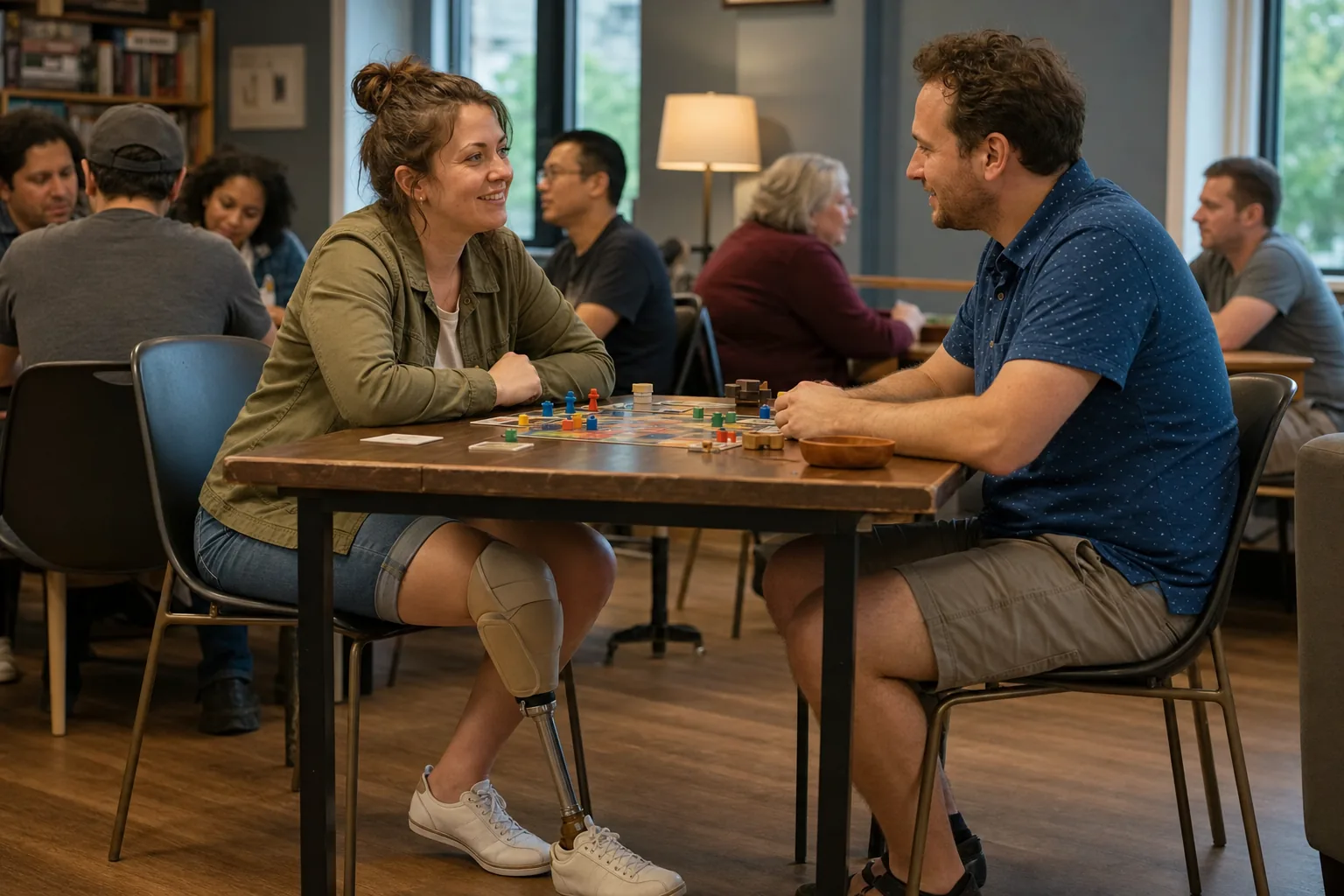
The best offline opportunities are usually recurring. A one-night mixer asks everyone to make a fast impression. A monthly board-game evening, adaptive sports session, museum program, community choir, craft class or volunteer shift lets people notice how you listen, joke and handle ordinary moments.
Choose something you would still be glad to attend if no date came from it. That protects the activity from feeling like a failed mission and makes your interest believable. Disability support groups and peer spaces also deserve boundaries. Join them for their stated purpose, not as a private dating list. If mutual interest grows naturally, let consent and the group’s rules guide what happens next.
A simple access question for an organizer
“I’d like to attend Thursday. Could you confirm the step-free route from arrival to the activity room, and whether the restroom and seating are accessible? If there is a quieter time or written activity information, I’d appreciate that too.”
Vague “accessible venue” labels are not enough for every body or communication style. The ADA National Network’s event-planning guide looks at the whole experience, including arrival, routes, activities, communication and public amenities. Ask about the feature that determines whether you can participate rather than requesting a general promise.
Match the plan to your actual energy
A strategy that works only during a perfect week will be difficult to sustain. Build a small menu for different energy levels.
- Five-minute option: reply to one promising message or save one local event.
- Thirty-minute option: update a profile prompt, join an online class or call an organizer.
- Social-energy option: attend a recurring activity with a planned arrival and exit.
- Home-based option: take part in a moderated online group, voice chat or video event connected to a real interest.
This is especially useful for fluctuating conditions. Cancelling one plan should not erase the entire month.
Make the first move without making it strange
Online, mention one profile detail and ask an easy question. In person, begin with the shared situation. Neither opening needs to mention disability.
- On a dating site: “You mentioned neighborhood theater. I always end up talking about the set afterward—what’s the best production you’ve seen lately?”
- At a class: “Have you taken one of these before, or are you also pretending the instructions make sense?”
- After two good conversations: “I’ve enjoyed talking with you. Would you like to get coffee after the next session?”
Watch for reciprocity. Do they ask something back, remember a detail or choose to continue the conversation? Warmth is pleasant; mutual effort is the more useful signal. For message and invitation examples, see our disabled dating tips.
Keep disability in proportion
Wanting a partner who understands disability is different from collecting diagnoses or treating assistive devices as a sexual category. A respectful person is curious about you and accepts a boundary. A concerning person repeatedly redirects the conversation to your body, care needs, medical history or how “inspiring” they find you.
You can answer, redirect or end the conversation. “I’m happy to discuss what helps a date work, but I don’t share medical details this early” is complete. Nobody earns private information by expressing interest.
Turn a promising introduction into a small meeting
Do not wait for total certainty. Look for consistent details, balanced conversation and respect for pace. Then suggest a short video call or a public meeting with a clear duration. “Would you like to meet for coffee Saturday? An hour works well for me, and I can confirm the access before we go” is easier to answer than “We should do something sometime.”
Use an independent way home, share the plan with someone you trust and keep the first venue public. RAINN’s current dating safety guidance also recommends staying in control of transportation and preparing an exit. Our accessible first-date guide helps check the venue, communication, timing and backup plan.
If an online contact requests money, gift cards, cryptocurrency or financial access, stop. The Federal Trade Commission’s romance-scam guidance explains common patterns and reporting steps. More privacy and warning-sign guidance is available on AbleMatchup’s dating safety page.
A 30-day plan that leaves room for a life
- Week 1: define relationship direction, practical distance and three non-negotiable values. Choose one dating platform.
- Week 2: finish the profile and identify one recurring accessible interest activity, online or local.
- Week 3: send three specific messages and attend or register for the activity. Do not judge the plan by one reply.
- Week 4: invite one mutually engaged person to a small next step. Review what produced comfortable, relevant conversation.
Measure more than matches. Count conversations where both people contributed, introductions within a realistic distance, invitations you felt able to make and how much recovery the process required. If the numbers are low but the conversations are better, that may still be progress worth keeping.
Meeting Disabled Singles FAQ
Where can I meet disabled singles near me?
Use one dating platform with active local profiles and one recurring interest-based activity that publishes useful access information. Local adaptive recreation, arts programs, volunteering, book groups and community classes can create repeated contact without making disability the only topic.
Are specialist disability dating sites better than mainstream apps?
Specialist sites make romantic intent and disability context clearer, while mainstream apps may offer more nearby profiles. Compare local activity, accessibility, privacy, safety tools and conversation quality instead of assuming one category is always better.
How can homebound disabled adults meet people?
Start with accessible dating platforms, moderated interest communities, online classes and video-based events. Use voice, video or text at a comfortable pace, protect home and care details, and consider a short virtual first date before planning an in-person meeting.
Should I mention disability when I first meet someone?
There is no required timing. Share when it supports comfort, honest expectations or practical planning. You can name an access need without explaining a diagnosis or full medical history.
Can a nondisabled person join a disability dating site?
It depends on the platform’s membership rules. Where allies are welcome, be honest about who you are, date people rather than disability categories and respect boundaries around medical questions, assistance and privacy.
This article provides general dating, accessibility and safety information. Access needs and local opportunities vary. The Pew figures describe U.S. online dating users generally, not disabled users as a separate group.
Start With One Useful Introduction
Create a profile that gives local people something real to talk about, then choose a pace that works in your life.
Join AbleMatchup Free