
A quiet café sounds like an easy first date until the grinder starts, the table faces a bright window and a queue forms beside your chairs. “Quiet” described one part of the visit. It did not tell you whether you could enjoy a conversation there.
Useful sensory-friendly date ideas give you something you both want to do, in conditions you can discuss and check. That might be a seated gallery visit, a familiar café, a short outdoor route or a film with suitable access arrangements. None is automatically right for everyone. The details that matter are the ones that let both of you take part.
Start with the conditions, not a label
Autism Central explains that sensory experiences vary between individuals and can change with factors such as the environment, sleep and emotional state. Some people want less of a particular input; others enjoy more of it. Its overview of sensory differences is useful background, not a checklist for deciding what your date will like.
If you are looking for autistic date ideas, ask the person rather than choosing from a presumed set of autistic preferences. You can also ask for a different setting without sharing a diagnosis.
Start with an ordinary invitation: “I’d like to see you. Is there anything about noise, lighting or crowds that would help us choose somewhere?” Offer your own information too: “I need enough light to see your face, and background music makes conversation difficult.” You do not need to cover every possible sensation. Begin with what could change the decision.
Separate a requirement from a preference when you can. “I would enjoy somewhere outdoors” leaves room to discuss alternatives. “I cannot stay in a room with flashing lights” rules some options out. Neither person has to prove why a requirement is real.
Six date ideas, with the detail that can change each one
A familiar café with a table you can choose
If you want to talk, a place one of you already knows gives you a starting point. Ask about the table, background music and what happens at the time you would visit. A corner seat may be beside a speaker; a window table may have glare. A quieter hour is useful information, not a promise about every visit.
Keep the date itself simple: bring a book you would recommend, compare notes on a film or order a drink you actually like. You do not need a second venue to make the meeting count.
A bookshop browse with somewhere to sit afterwards
Browsing gives conversation something to attach to. You could each choose a book with an intriguing opening or show the other person a section you know well. Agree that buying anything is optional.
Check music, events and seating rather than assuming a bookshop is quiet. If reading small print or standing makes the activity difficult, you could bring a favourite passage in a format you use and discuss it at a suitable table instead. Preserve the shared interest; change the task.
One part of a gallery or museum
Choose an exhibit you both want to see rather than trying to complete a building. Look for visitor information about lighting, sound installations, expected crowds and places to sit. A gallery can contain bright projections, echoing rooms or sudden audio, even when its publicity looks calm.
If a venue publishes a sensory map or access guide, use it to ask about the particular room and route. The National Autistic Society’s accessible environments guidance describes sensory maps, quieter times and environmental adjustments. A general guide does not confirm conditions for your booking.
A short outdoor visit with a clear turning point
A garden, seated waterfront stop or familiar park route may appeal if you enjoy being outside. Decide where you will meet and where you can stop or turn back. Walking is optional; a shared view can be the activity.
Outdoors does not necessarily mean low sensory input. Wind, traffic, dogs, pollen, glare and nearby events can change the setting. Check the actual conditions that matter to you, along with seating and the route. A café is only a useful weather backup if that café also works for both people.
A game or small creative activity at a suitable table
A familiar cooperative game, sketching or making a small collage can give you something to do together without a constant stream of questions. Choose the task together. Pieces, textures, smells, instructions and time pressure can matter as much as the room.
For a first meeting, look for an appropriate public setting rather than assuming you must invite a new contact home. Check whether you can pause or leave without finishing. A booked workshop may be enjoyable, but its fixed pace is a different commitment from bringing a simple activity to a table.
A relaxed screening of a film you actually want to see
Read the arrangements for the specific performance: what happens to sound and lighting, whether moving or leaving is allowed, and what the film contains. A “relaxed” label needs an explanation, especially if captions or another access feature also matters.
In a 2023 BFI essay about relaxed screenings, Lillian Crawford describes different audience responses to the same sung-through musical: some found it soothing, while others found the continuous music intense. A lower volume cannot tell you everything about the experience. Choose the film as carefully as the screening format.
Ask for a description you can make a decision from
“Is it sensory-friendly?” may get an enthusiastic answer without resolving your question. Name the feature and the time. You can share the planning: one person checks the venue, while the other checks their own journey or the activity details.
An illustrative café enquiry
“We’re considering Saturday at two. Do you play background music in the seating area? Is there a table away from the speaker and coffee machine that we can reserve? Are any events planned during that time?”
Ask a follow-up only where you need one. “No music, but the only available table is beside the grinder” might rule the café out. “Usually quiet” leaves more uncertainty. Neither response is a guarantee; the aim is to learn enough to decide whether to book, ask another question or choose somewhere else.
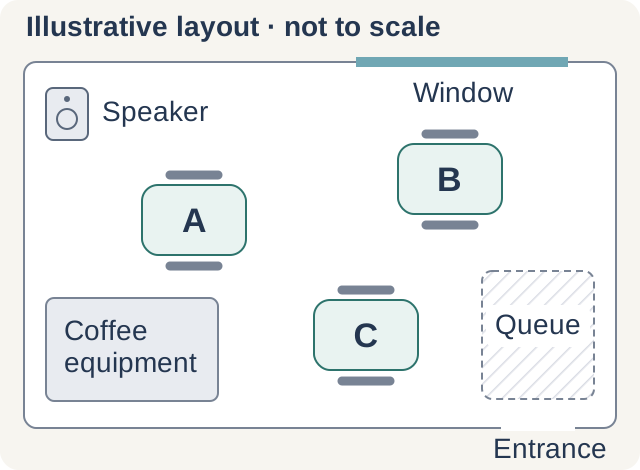
- Table A · sound
- Near the speaker and coffee equipment. Ask about background music and equipment noise during your visit.
- Table B · light
- Beside the window. Ask whether glare or direct sun affects the table at the time you would arrive.
- Table C · people passing
- Beside the queue. Ask where people wait and whether they pass close to the seats.
No table is automatically the right choice. Use the features that matter to both of you; this sketch does not show measurements, toilet access or a verified route.
If the main issue is travel, entrances or facilities, use the first-date planning guide for those checks. A room that suits your senses still needs to be somewhere you can reach and use.
Follow one invitation through to a workable plan
This is an invented planning example, not a venue review or a report about members.
Two people want to visit a Saturday book event and talk afterwards. One enjoys hearing writers discuss their work but finds overlapping voices difficult. The other needs a well-lit place to follow the conversation. Their shared interest is books; neither has committed to the event itself.
They ask the organiser whether the event has a moderated talk, whether there is amplified background music afterwards and whether a separate table can be reserved. The reply says the talk is followed by an informal standing reception in the same room. There is no separate seating area.
That is a useful answer. Moving to the darkest corner would not solve both people’s needs, and hoping the reception stays quiet leaves the deciding issue unresolved. They skip that event and arrange to discuss a short story at a café whose seating and background conditions they have checked. Each brings one passage they liked.
The café plan is still conditional on what they find that day. They agree that if conversation is difficult, they can end the visit and arrange another time. They do not need to preserve the original event to show enthusiasm about each other.
When your comfortable settings do not match
One person may like dim lighting while the other needs to see faces clearly. One may enjoy an animated room while the other cannot follow conversation there. Choosing a halfway point between two incompatible requirements may leave neither person comfortable.
Look for a different arrangement before asking someone to tolerate the barrier. Could you choose even lighting away from glare? Could the person who enjoys activity choose the exhibition while you both use a quieter time or space? The attraction of the date might come from what you share, without requiring the same background conditions.
Try: “I want us both to enjoy this. I need a room without music to follow what you’re saying. What would make that kind of place interesting for you?” The answer may reveal another shared interest. It may also show that this particular outing is not a fit.
If the only available version requires someone to push through a stated limit, choose another activity or another day. You can care about another person’s enjoyment without agreeing to every plan.
Leave room to change your mind when you arrive
A website cannot describe the birthday group at the next table or a speaker moved that morning. Agree beforehand how you will signal that something is not working. Plain words can be enough: “I’m interested in staying with you, but I need to leave this room.” If speech is difficult in that situation, agree on a text or signal you can both recognise.
You can ask for the specific change you want, take a break or end the date. Do not assume your date wants touch, more questions or an immediate move to another venue. Ask what would help and give them room to answer. If the plan cannot be adjusted, ending it is a valid choice.
Keep what you enjoyed, not the whole itinerary
Afterwards, separate the setting from the connection. “I liked talking about that story. The room got too busy for me; next time I’d like somewhere without a shared event” says more than “Was the date okay?” It tells the other person what you want to repeat and what needs to change.
For other ways to share an interest, the accessible date ideas guide offers broader activity choices. The point of checking the setting is to make room for the part you came for: finding out whether you enjoy spending time together.
Sources checked October 21, 2026. Venue questions and the worked plan are editorial examples, not field tests. This article offers dating and access-planning guidance, not assessment or treatment of sensory differences. The cover is an AI-generated illustration of a gallery date, not an inspected venue.