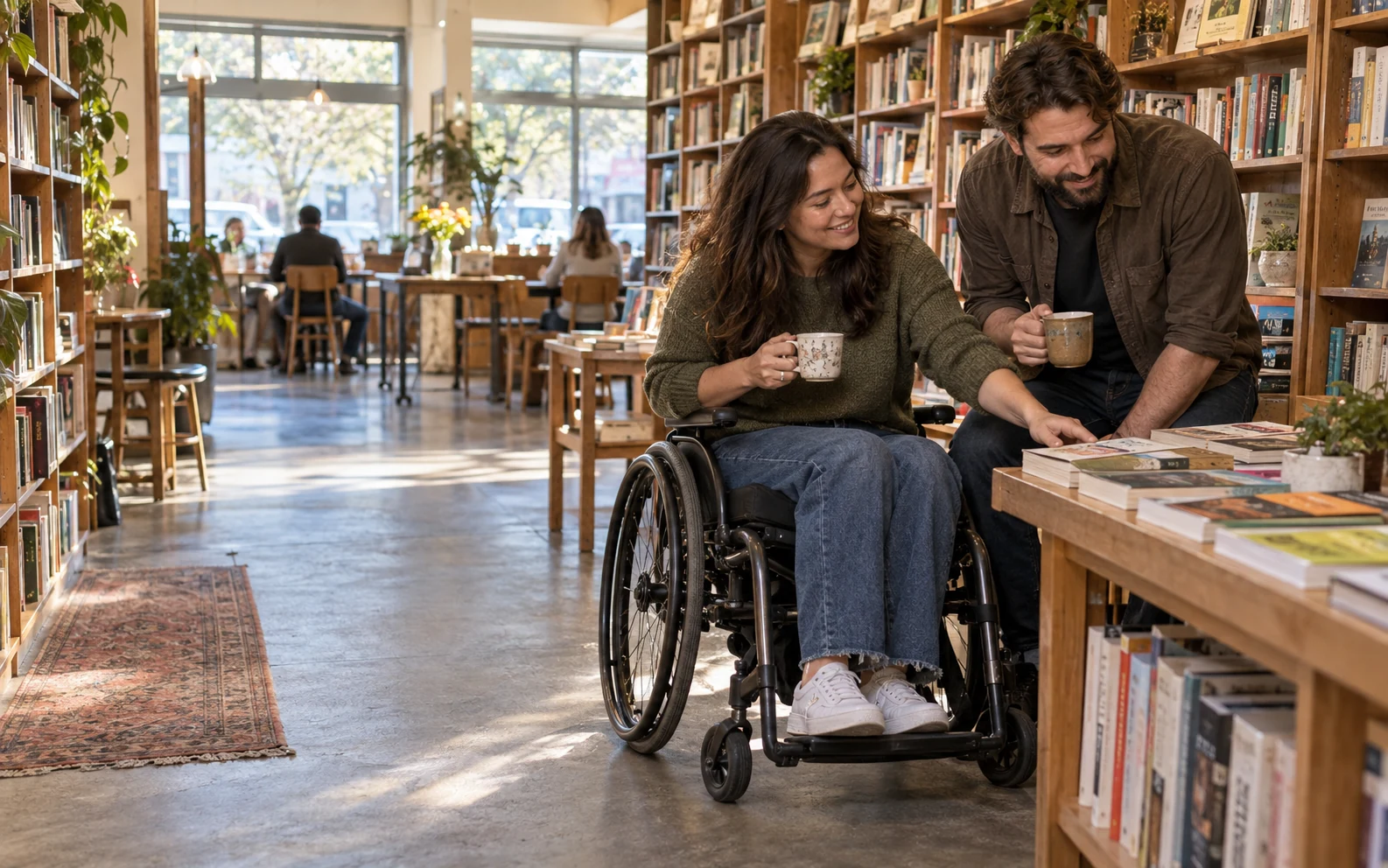
Start here when you need an activity worth doing together. Once you have chosen one, the first-date planning guide helps you confirm routes, facilities and a backup.
Quick Answer
The best accessible date ideas do more than remove a barrier. They give both people something to notice, talk about or laugh at together, while keeping the practical parts quietly handled. A bookshop with tea, a short gallery visit, a market with a clear meeting point or a shared cooking class can work beautifully when the plan has an easy arrival, a comfortable pace and a simple way to change direction.
Do not confuse “accessible” with “carefully managed.” You are allowed to want a date that feels attractive, playful and a little unplanned. The useful trick is to sort the access details early, then stop talking about logistics long enough to actually get to know each other.
There is a particular kind of first-date message that can drain the fun before anyone has met: “What do you need? Is this okay? What about this? Or this?” It often comes from a kind place, but it can turn one person into the project manager of their own date. On the other side, “Let’s just see what happens” can mean somebody has not thought about the entrance, the noise, the seating, the journey home or the fact that a two-hour plan may not be a two-hour body day.
Good accessible date ideas sit between those two extremes. They are not a medical questionnaire and they are not a gamble. They are ordinary plans with a little thought behind them. That thought is what lets the date feel less like an appointment and more like two people deciding whether they enjoy each other.
A date has two layers: the plan and the texture
The plan is the practical layer: how you get there, where you enter, whether there is seating, what happens if the venue is loud, crowded or unexpectedly closed. The texture is why the date feels like a date: a shared opinion, a small discovery, a chance to tease each other about book covers or compare desserts.
Many lists of accessible date ideas only deal with the first layer. That is why they can read like errands. A lovely date needs both. You might choose a café because it has step-free access, but the texture comes from a corner table, a window, and the person across from you telling a story they have not told anyone else that week.
| Date format | Practical layer | Texture that makes it feel shared |
|---|---|---|
| Bookshop and tea | Wide aisles, seats nearby, one clear entrance | Pick a book for each other from a section you would not normally visit |
| Small gallery | Short route, benches, predictable lighting and toilets | Each choose one work you would happily take home and one you would never hang up |
| Food market | Go at a quieter time, agree on a meeting point and a rest option | Buy one thing for the other person based on a five-minute conversation |
| Home-style cooking class | Confirm counters, seating, dietary needs and duration | Divide the jobs badly on purpose and see who is secretly competitive |
Try the 70/30 rule
A first date does not need an exact formula, but this one is useful: let roughly 30 percent of the planning conversation cover access and timing, then leave the other 70 percent for ordinary anticipation. Talk about the exhibit you both want to see. Send a photo of the absurd pastry menu. Ask whether they are a museum map person or a wander-until-lost person.
If the logistics keep taking over, the plan may be too complicated for a first meeting. Smaller is often more romantic than heroic.
Four date formats that leave room for a real connection
You do not need a dramatic experience. You need an environment where both people can be present. Here are four formats that work for different moods, energy levels and communication styles.
1. The parallel date
Parallel dates give you something to do beside talking. Browse a bookshop, make a collage at a community art table, work through a board-game café menu, or wander a well-planned indoor market. The activity takes the pressure off constant eye contact and gives the conversation natural pauses.
They can be especially good if either person gets anxious, uses a communication device, prefers quieter conversation, has fluctuating energy or simply finds “tell me about yourself” exhausting. The best version is one with no penalty for stopping early.
2. The one-good-stop date
Pick one place and let it be enough. A 75-minute lunch, a late-afternoon tea, a single gallery floor or an outdoor concert viewed from a seated area can be far more enjoyable than trying to fit in drinks, dinner and a long walk because that is what dating is supposed to look like.
A limited plan gives you an honest exit. It also gives you a pleasant surprise if neither person wants to leave. “Do you want to get another tea?” is more charming when it is a choice, not a rescue mission for a four-hour itinerary.
3. The choice-within-a-choice date
This is a useful one when the first plan depends on energy, weather or sensory conditions. Start with a base location, then give yourselves two small routes. At a museum, you might choose between the photography room and the sculpture garden. At a food hall, you might sit first or do one slow lap before deciding.
It feels spontaneous because it is, but the spontaneity sits inside a structure you already know is workable. That distinction matters. Nobody has to pretend they are fine with a situation that is plainly not going to work.
4. The familiar-place invitation
Sometimes the most generous date idea is an invitation into a place one person already knows well: a local café with a reliable quiet hour, a waterfront route with decent paving, a cinema with captions, a neighborhood market where the staff know the accessible entrance. Familiarity is not boring. It means one person can relax enough to be themselves.
Let the other person bring the surprise
The familiar-place date works best when it is not a one-person show. One person can choose the dependable location; the other can bring a question, a small snack, a playlist for the ride home or a funny story about the area. Shared effort is more important than making everything symmetrical.
How to invite someone without making access feel heavy
A thoughtful invitation does not need a long preamble. It gives enough information to answer, leaves room for preference and does not ask the other person to disclose more than they want to.
- Bookshop version: “Would you be up for tea at Alder Books on Saturday? It has a level entrance, plenty of space and a café inside. We could keep it to an hour or stay longer if we are having fun.”
- Gallery version: “I was thinking about the small photography show at 2 p.m. They have benches and it is usually quiet then. Would that suit you, or would you rather do something simpler?”
- Low-energy version: “I would like to meet you. I am best with a short, easy plan, so how about coffee near the station and we see how the conversation goes?”
- Sensory version: “There is a café I like because it is calm before lunch. Want to try it, or should we find somewhere even quieter?”
Notice the common pattern: one concrete suggestion, one piece of useful information, one genuine choice. That is enough. Once the other person says yes, you can get back to talking about something more interesting than door widths.
When the plan goes wrong, use a soft landing
Even a well-checked venue can let you down. A lift is out of service. The quiet room has a birthday party in it. Rain turns a short route into something miserable. A pain flare arrives with the timing of a bad joke. None of this means the date failed. It means the original plan has reached its limit.
The useful thing to prepare is not an elaborate Plan B. It is a soft landing: one smaller, easier option that protects the mood. A nearby café. Ten minutes on a bench before deciding. A video call later that evening. A clear, kind end to the date with a suggestion for another day.
The three-sentence switch
- Name the problem without making it anyone’s fault: “This place is much louder than it looked online.”
- Offer one easier option: “There is a quiet tea place across the street, or we can call it here.”
- Give the other person room to choose: “What would feel best?”
That small sequence matters because it does not turn a practical barrier into a character test. Nobody has to apologise for their body, and nobody has to perform endless optimism to prove they are still fun.
Do not hand all the planning work to one person
Accessibility planning often lands on the disabled person by default. They know what to ask, they know the usual problems and they are used to doing the extra research. On a good date, that expertise is respected without being treated as unpaid administration.
Try a simple split. One person checks the specific access detail that matters. The other checks opening hours, books the table or chooses the activity inside the place. If you are unsure what would help, ask one focused question instead of making the person design the whole evening from scratch.
For the practical details behind that check, our accessible first-date planning guide covers entrances, transport, toilets, communication and backup options. This article is about what happens after those basics are handled: the part where you get to flirt, listen and decide whether you want dessert.
A better question after an accessible date
Afterward, people often ask, “Was it accessible?” That matters, but it is only half the story. Try asking a second question: “Did either of us have to work too hard to make the date happen?”
If the answer is yes, that does not automatically mean the connection is wrong. It may mean the venue was a poor fit or the plan had too many moving parts. What matters is how the two of you handled it. Did someone listen? Did they adjust without sulking? Did you get to talk about music, work, family, terrible television and whatever else makes a person more than their access needs?
Those moments are the real test. A date does not become romantic because it is elaborate. It becomes romantic when both people can relax enough to notice each other.
Make Room for the Date You Actually Want
Join AbleMatchup to meet people who understand that comfort, clear plans and chemistry can belong in the same evening.
Join AbleMatchup Free