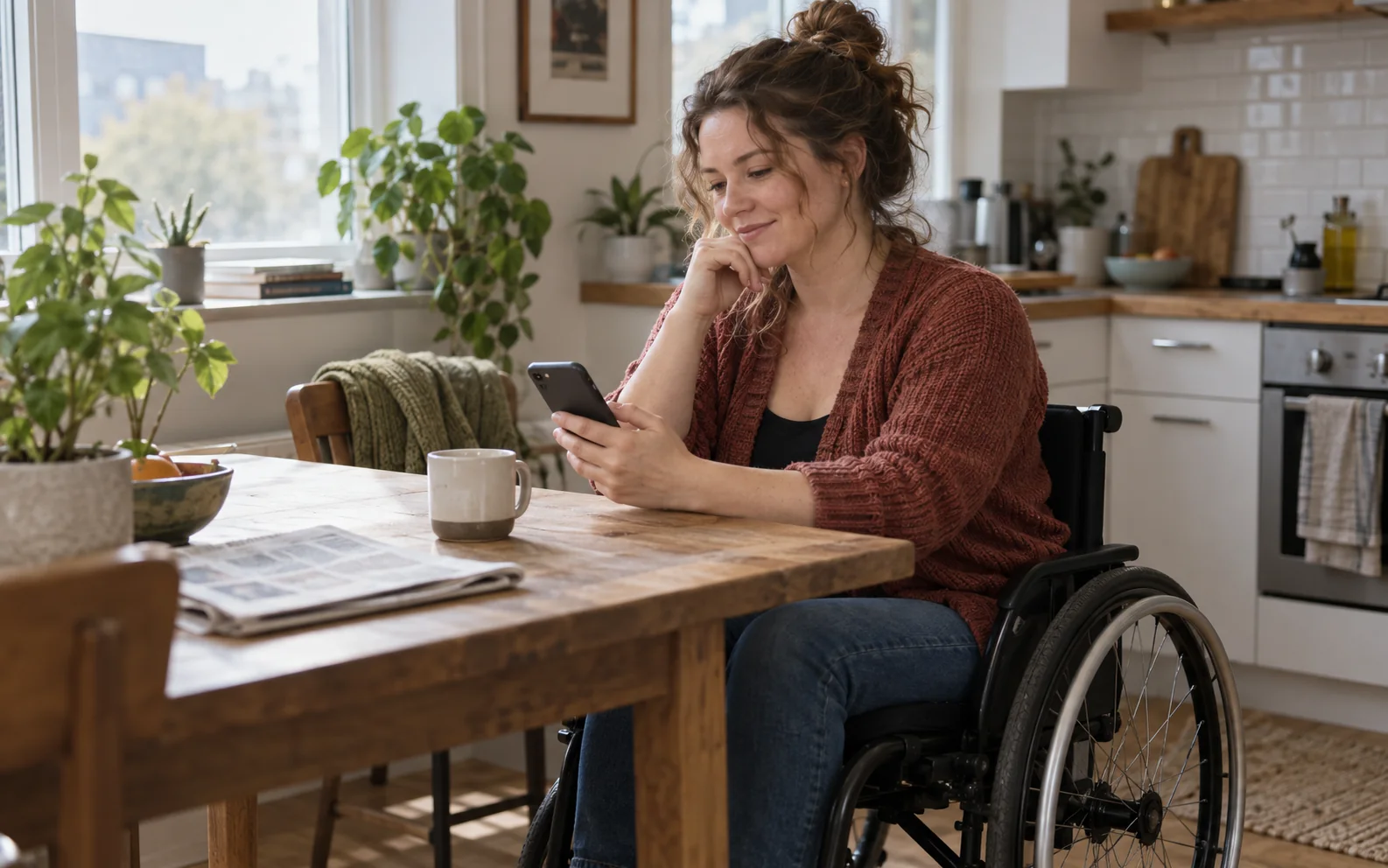
A good first message names one real detail from the other person's profile, adds a little of your own personality and leaves an easy way to answer. It does not need to mention disability unless the person has made an access or communication preference relevant to the conversation. The examples below are starting points, not lines to paste into every chat.
Picture the ordinary moment: a match appears while your tea is getting cold. Their profile mentions a tiny weekend ritual and a photo at a market, but your mind offers only “Hey, how are you?” You could send that. You could also use the detail they chose to share. The second option gives the other person somewhere to begin.
Give the other person a reply handle
A reply handle is a small, answerable opening: a choice, an opinion or a story they can tell in one or two sentences. “Tell me everything about yourself” makes a stranger do a lot of work. “Was the pottery class as chaotic as it looks?” is easier. A first message does not have to be clever. It has to sound as though it belongs to this person.
Look for a detail they volunteered: a book, a recipe, a pet, a place they return to, an unusually specific prompt answer. Say why it caught your eye, then ask one question. If their profile already gives you two possible topics, pick the one you would enjoy discussing. That matters more than finding a supposedly perfect opener.
If your own profile is too vague for someone to return the favour, our disabled dating profile examples show how a few concrete details make starting a conversation easier on both sides.
First message examples for different kinds of profiles
These are fictional examples. Change the activity, wording and question to fit what the person actually wrote. A message about hiking to someone who mentioned baking is still a generic message, even if it sounds polished.
When their profile gives you a clear interest
- They mention weekend baking: “Your cardamom-bun experiment sounds excellent. I keep trying to make a decent lemon cake and getting impatient with the icing. What's the bake you make when you want a guaranteed good result?”
- They show a market photo: “The Saturday market in your photo looks like my kind of morning. I usually leave with bread and something I didn't mean to buy. What stall keeps pulling you back?”
- They love live music: “You mentioned small gigs rather than big venues, and I agree that being able to hear each other afterwards is half the fun. What was the last show you really liked?”
Each message offers something of your own before asking. That keeps the opening from feeling like a questionnaire. The details also make it possible for the other person to answer without disclosing anything private.
When their profile tells you how they like to communicate
- They prefer text over calls: “I saw that text is easier for you than a surprise phone call. Same here for getting to know someone. Your ceramics photo caught my eye—what were you making?”
- They prefer direct questions: “Your line about liking clear questions made me smile, so here's one: would you choose a quiet bookshop afternoon or a food market morning?”
- They mention a slower reply pace: “No rush to answer. I liked what you wrote about collecting old cookbooks—have you actually tried one of the stranger recipes?”
Respecting a stated preference is useful. Turning it into an interview about why they need it is not. Someone who mentions captions, sign language, processing time or low-energy days has given you a way to communicate well, not an invitation to request a diagnosis. For more on arranging communication around the person, see our Deaf dating guide.
When you share an interest or your own access preference
- A shared low-key weekend: “Your ideal Sunday sounds familiar: a slow breakfast and somewhere interesting to wander. Mine usually ends at a second-hand bookshop. What's the place you never get tired of?”
- You want to set a comfortable pace: “I liked your idea of keeping first plans simple. I'm a daytime-coffee person too, though I can spend far too long choosing a pastry. What's your reliable order?”
- The profile is sparse: “Your photo at the coast caught my attention. I went for a very windy walk last weekend and still came home happier. Was that a favourite spot or a one-off trip?”
With a sparse profile, one specific, low-pressure attempt is enough. You do not have to invent a whole personality from one picture or keep sending questions if the conversation stays one-sided.
If disability appears in the profile, follow the person's lead
A wheelchair, white cane, hearing device or mention of chronic illness may be visible in a profile. It is still rarely the best first topic. If someone shares a photo from a cooking class and happens to use a wheelchair, ask about the food or the class. If they explicitly say “Ask me about accessible travel,” then travel is an offered topic. Read the distinction the person has made.
There are exceptions: a shared experience can be a genuine point of connection. “I also use a cane, and your comment about planning a route before a gig made me laugh. What's the last venue that got it right?” can work if that is honestly your experience and the profile invites it. Do not manufacture common ground or ask a stranger to explain their medical history to you.
Replace an intrusive opener
Instead of “What happened to your legs?” try “Your photo at the outdoor cinema looks fun. Was the film worth staying for?” Instead of “Can you date normally?” ask about something they chose to share. A respectful first message treats disability as one possible part of a person's life, not the whole introduction.
If you are deciding what to disclose about yourself, the dating privacy guide separates useful planning details from information you may prefer to keep private.
The message after the first message matters too
An opener has done its job if the other person has something to answer. Then listen to the answer. Do not immediately switch to the next prepared question. Pick up one detail, respond with your own small story and let the conversation develop.
A short exchange that moves naturally
You: “Your profile says you love little museums. I found one devoted entirely to old radios last month. What's the most unusual one you've visited?”
Them: “A tiny maritime museum. I went for half an hour and stayed all afternoon.”
You: “That's exactly the kind of accidental afternoon I like. Was it the exhibits or the person giving the tour that kept you there?”
Them: “The volunteer had stories about every object. I think I'd go back just to hear him again.”
The second message works because it follows their answer. You do not need a complicated script. When the exchange feels comfortable, a small invitation can follow: “Would you like to continue this over coffee next week?” If meeting requires access planning, talk about the practical details together rather than guessing. Our first-date planning guide can help with that step.
What makes an opening harder to answer
- Appearance-only praise: “You're gorgeous” gives little to discuss and can feel especially reductive when it focuses on a visible disability or mobility aid.
- Three questions at once: An opening is a conversation, not an application form. Ask one thing and see where the reply goes.
- Borrowed intimacy: Pet names, sexual comments and claims that you have a special connection before you have talked can create pressure.
- Access as an interrogation: “Can you walk?” or “What's your diagnosis?” asks for personal information before you have built any trust.
- A copied joke you would never say aloud: If you cannot imagine yourself saying it over coffee, rewrite it in your own voice.
Be wary if someone immediately pushes to move off the dating service, asks for money or tries to make you feel guilty for keeping boundaries. The FTC's romance-scam guidance explains how requests for money can enter an online relationship. Our online dating safety guide
If they do not answer
A thoughtful message can still receive no reply. The person may be busy, taking a break, talking to someone else or simply uninterested. You cannot know which from a silent inbox. Do not turn one unanswered message into a verdict about your disability or your worth.
If the conversation had already started and then paused, one gentle follow-up after some time is enough: “I enjoyed hearing about your museum trip. No pressure to reply, but I'd be glad to keep talking.” If your first message never drew a response, moving on is usually kinder to yourself than repeated attempts. For a more sustainable rhythm, read our guide to disabled dating burnout.
Before you press send
Read the message once as if you were receiving it. Does it refer to something the person actually shared? Can they answer without revealing private information? Does it sound like you? Is there only one clear question? If yes, send it. The aim is a human opening, not a flawless performance.
Give Someone a Real Way to Reply
Start with a profile that shows a little of your everyday life, then use the same care when you write to someone else.
Join AbleMatchup Free