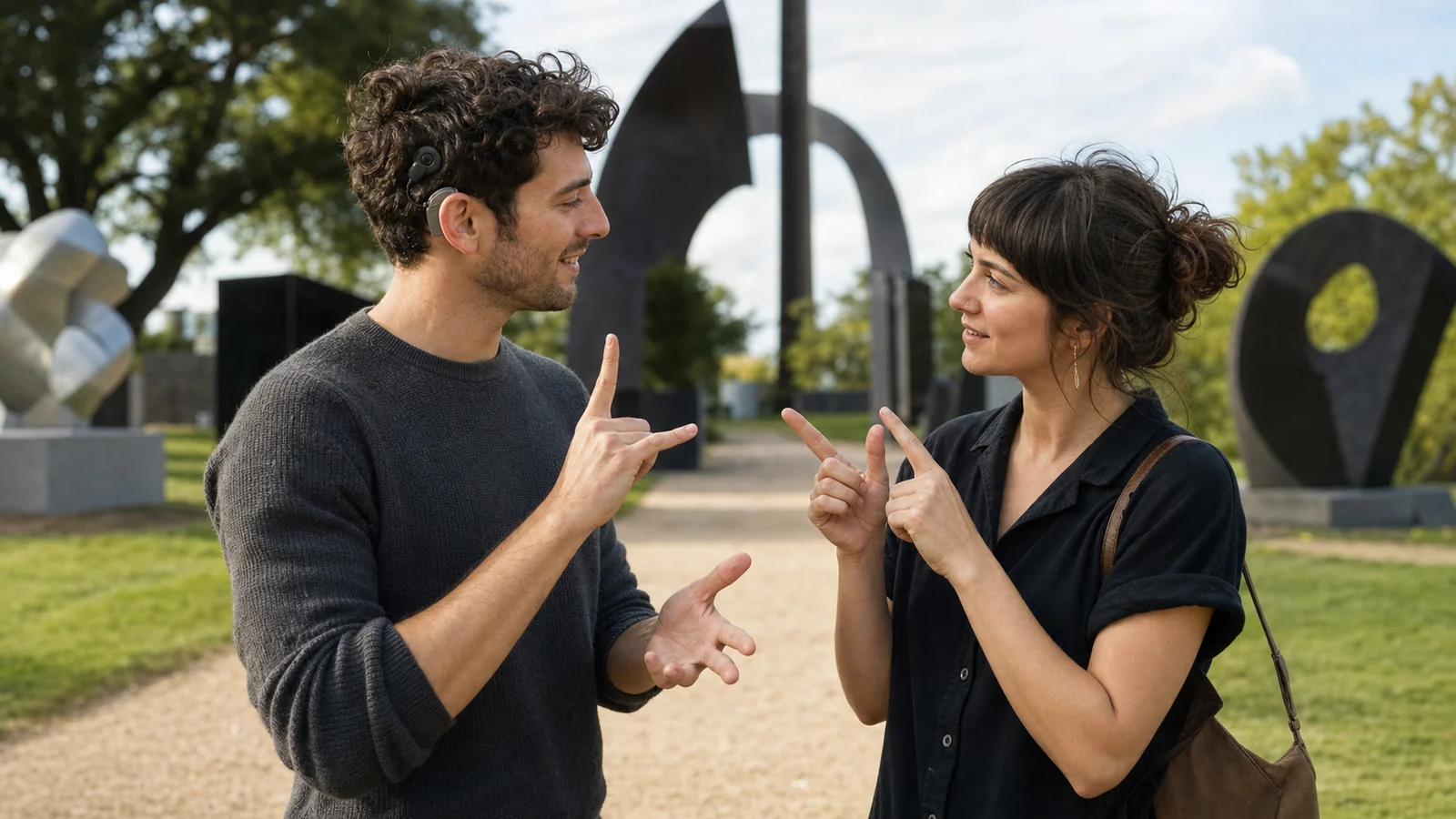
Deaf dating includes people with many identities and communication styles: Deaf sign-language users, deaf and hard-of-hearing people, late-deafened adults, cochlear-implant users, hearing-aid users and people who use no hearing technology. Two people with similar audiograms may communicate very differently. The most reliable dating skill is not guessing—it is asking, adapting and paying attention to what makes conversation effortless for both people.
Communication is a shared responsibility
Ask whether your date prefers sign language, speech, captions, text, lipreading or a combination. Face them in good light, reduce background noise, keep your mouth visible, and repeat or rephrase without frustration. Access should not depend on the Deaf person doing all the extra work.
Understand that Deaf identity is not one story
Capital-D Deaf often refers to cultural identity and connection with a signing community, while lower-case deaf may describe hearing level. People use these terms differently, so mirror the language a person uses for themselves. Do not assume everyone wants to hear, identifies as disabled, can lipread, or regards technology as a cure.
Deaf culture may include its own humour, social norms, art and history. Sign languages are complete natural languages; British Sign Language and American Sign Language are different languages, not signed versions of English. If a date says signing is central to their life, treat that as meaningful cultural information rather than a communication inconvenience.
Avoid making devices the opening interview
Hearing aids and cochlear implants can improve access for some people, but they do not reproduce typical hearing or remove listening fatigue. Device use is a personal and sometimes political choice. Ask what helps in the current setting instead of requesting technical history.
Ask about communication preferences before meeting
A short message can prevent a long, tiring date: “What communication setup works best for you in person?” The answer may change by environment. Someone might use speech easily in a quiet room, prefer captions for video calls and use sign language in groups.
| Method | Helpful dating practice | Avoid |
|---|---|---|
| Sign language | Keep hands and face visible; learn basic greetings; arrange an interpreter for a complex public event if requested. | Pretending to understand or treating signing as performance. |
| Lipreading | Face the person, use natural speech and good front lighting. | Exaggerating mouth movements, shouting, covering your face. |
| Speech and hearing tech | Choose low background noise; rephrase missed words; take listening breaks. | Assuming devices make every setting accessible. |
| Text or live transcription | Keep a notes app ready; verify names and key details in writing. | Talking while looking away and expecting software to be perfect. |
| Captions | Enable accurate captions before a video call or film. | Relying on automatic captions for sensitive details without checking. |
RNID’s communication guidance recommends getting attention before speaking, facing the person, speaking clearly, reducing background noise and repeating or rephrasing when necessary. These are small habits, not a special performance. See the RNID communication tips.
Make profiles, calls and messages accessible
For a Deaf dating profile, show interests and relationship goals first. Mention communication preferences in a direct, positive way: “BSL is my first language; I also use text and some speech.” This gives a potential partner a clear route into conversation. You can add whether you welcome beginners in sign language without becoming an unpaid teacher.
Video calls need preparation too
- Place the camera so your face, hands and upper body are visible.
- Use steady front lighting, not a bright window behind you.
- Enable captions and check that they do not cover hands.
- Take turns and pause between speakers so transcription can catch up.
- Use chat for addresses, names and details that must be exact.
A hearing person who learns a few signs shows care, but fluency takes time. Do not claim you “know sign language” after learning the alphabet. Ask which learning resources the Deaf person trusts, and practise without expecting praise for every sign.
Choose a venue where faces and conversation stay clear
Restaurants often look romantic while being acoustically and visually difficult: dim lighting, loud music, reflective surfaces and staff speaking from behind can make communication exhausting. A quieter café with even lighting may create more intimacy because both people can relax.
The visual-access venue check
- Lighting: Can you see each other’s faces and hands without glare?
- Noise: Is music low, and can you sit away from speakers or a busy bar?
- Seating: A round or corner table may support eye contact better than sitting in a line.
- Information: Are menus, announcements and booking details available in writing?
- Activity: Will the event require looking away while someone speaks?
At a theatre, lecture or tour, confirm captioning or interpretation with the organiser. Ask whether captions are open, device-based or displayed through glasses, and whether the advertised interpreter covers the full event. Do not make the Deaf person call repeatedly; share the access work.
Keep a first-date conversation flowing
Get attention with a light wave, a tap on the table or another method your date prefers—not by grabbing them. Maintain eye contact while signing or speaking. If you miss something, say so immediately. Nodding along creates confusion and can make the other person doubt whether important information was understood.
- “I caught the first part, but missed what you said after the film title. Could you repeat or type it?”
- “The music has become loud. Would you like to move outside or try the café next door?”
- “I’m learning, so please correct my sign if you want to; I won’t be offended.”
- “Would you rather I book by text, or should we decide together?”
Do not make hearing ability the entire date. Ask about work, food, family, travel, books and ridiculous opinions. Communication access is the bridge to connection, not the destination.
Group dates need more structure
Friends should take turns, keep sight lines open and avoid side conversations. Introduce topics when the Deaf person returns to the table rather than saying “never mind.” In a signing group, hearing people should not continue a spoken conversation that excludes the signer. Inclusion is a behaviour, not a friendly intention.
Build a bilingual or mixed-hearing relationship
Long-term couples often create a shared communication system. That may include sign language classes, captions at home, visual alerts, text for logistics and deliberate quiet after a demanding listening day. The hearing partner should develop enough skill that the Deaf partner is not always translating their own life.
Conflict requires full access
Do not argue from another room, in darkness, while driving or with your face turned away. Slow down and make sure both people understand. Text can help clarify a point, but it can also remove tone; choose the channel together. If either person becomes tired, agree on a specific time to continue rather than abandoning the discussion.
Interpreters and privacy
Interpreters may be needed for healthcare, ceremonies or complex appointments. Speak to your partner, not about them to the interpreter. In social settings, do not assume a Deaf friend or child should interpret. Professional access protects accuracy and family boundaries.
Deaf dating online safety: make each check accessible
A safety check is useful only when both people can actually communicate. Before a first meeting, suggest a brief live conversation in a format that works for you: captioned video, signing on camera, text alongside video or another accessible option. Agree on the format in messages first. A hearing person should not insist on an uncaptioned phone call as the only way to “prove” identity.
- Set up the call. Use steady front light, keep faces and hands visible, reduce background noise and check captions before discussing details. Automatic captions can miss names, places and money amounts, so confirm anything important in text.
- Keep control of your contact details. If the dating service's call tool does not support your communication method, discuss a suitable alternative without sharing your address, workplace or main phone number simply to make the call happen.
- Notice pressure, not hearing status. Someone who refuses every accessible option, repeatedly pushes you to move conversations elsewhere, demands private information or asks for money is giving you a reason to pause. A live call helps with one check; it is not a guarantee of character.
- Plan the meeting independently. Choose a public venue with good lighting, send the address and meeting point in text, arrange your own journey home and tell a trusted person the plan.
RNID's communication advice includes practical video-call guidance on lighting and clear communication. For money requests, reporting and a broader first-meeting checklist, use the AbleMatchup online dating safety guide.
Respectful Deaf dating is not about becoming flawless overnight. It is about taking communication seriously, recovering from misunderstandings without blame, and building enough visual and linguistic access that both people can be funny, vulnerable and fully present.
That shared attention is the point.
Deaf Dating FAQ
Should I learn sign language to date a Deaf person?
Learn the language your partner actually uses. Basic signs can show care, and a serious relationship with a sign-language user usually requires sustained learning. Do not expect your partner to provide every lesson.
Can all deaf people lipread?
No. Lipreading ability varies and many speech sounds look identical on the lips. Treat it as one possible tool, not a complete replacement for captions, text or sign language.
Is it rude to ask about hearing aids or cochlear implants?
Device questions can be personal. Ask what communication support works in the current setting and wait for the person to offer technical or medical details.
Where should I take a Deaf person on a first date?
Choose a well-lit place with low background noise, clear sight lines and written information. Confirm captions or interpretation for events.
What should I do when I do not understand?
Say which part you missed, then ask for repetition, rephrasing, signing or text. Honest repair is more respectful than pretending.
This guide offers general dating and access-planning information, not medical or legal advice. Individual needs differ; ask the person and respect their answer.
Meet People Who Value the Whole You
Build a profile around your interests, values and relationship goals, with control over what personal information you share.
Create Your Free Profile