Disability dating advice often arrives in separate boxes: mobility, sensory, neurodivergence, chronic illness. Real lives cross those borders. A person may have multiple disabilities, a rare condition, acquired brain injury, learning disability, speech difference, facial difference, epilepsy, dwarfism, continence needs or an experience that does not have a public label. The respectful response is not to find the nearest stereotype. It is to understand the individual.
Use a personal-access approach
Ask how the person prefers to communicate, move through a place, manage energy and receive help. Confirm what matters for the specific date. A diagnosis may provide context, but it never replaces the person’s own instructions.
Replace category-based assumptions with useful curiosity
Two people with the same diagnosis may have different strengths, barriers and identities. One may embrace disabled identity; another may use a condition-specific term. Some use mobility or communication tools part-time. Some disabilities vary from hour to hour. Mirror the person’s language, and do not rank disability by visibility.
The WHO estimates that one in six people globally experiences significant disability and stresses that the group is diverse. It frames disability partly through barriers in environments and systems. For dating, that means a thoughtful setting can matter as much as the body. Read the WHO disability fact sheet.
Ask one question at a time
“Tell me everything I should know” can make a person produce a manual for themselves. Narrow the question: “Does the café setup work?” “Would text or a call be easier?” “Do you want help with the door?” Specific questions are easier to answer and keep health information proportionate.
Build a personal access note for dating
A short access note can reduce repeated explanations. It is not a medical record. It states what helps, what to avoid and what to do if plans change. Keep it on the platform until trust develops and remove identifying clinical information.
| Area | Example statement | What a date can do |
|---|---|---|
| Communication | “I process one question at a time and prefer plans in writing.” | Pause, use plain language and text the final details. |
| Movement | “Uneven ground is difficult, although short steps are okay.” | Check the route, not only the entrance. |
| Energy | “Ninety minutes is usually comfortable.” | Set an end time and make extension optional. |
| Sensory | “Strong fragrance and flashing light can make me unwell.” | Choose an appropriate venue and avoid scented products. |
| Assistance | “Ask before helping; verbal directions work best.” | Offer once, then follow the answer. |
| If plans change | “A quiet call is my lower-energy alternative.” | Offer the agreed option without guilt. |
You can share only the relevant lines. Update the note as you learn what helps. A partner should not distribute it to friends, family or venue staff without permission; they can communicate the access request without disclosing a diagnosis.
Share disability information with purpose
A dating profile should make room for personality: specific interests, values, humour, daily rhythm and relationship goal. Disability can appear as identity, practical context or not at all. Ask what you want the information to accomplish. Is it inviting community, filtering reactions, explaining a visible aid, or helping plan?
Keep private data separate from personal truth
You can be honest without sharing an address, medical documents, benefit status, care schedule, legal name or workplace. A real person will not pressure you for proof. When a relationship becomes established, deeper information should still be shared by agreement.
- “I’m disabled and happy to discuss what that means for dates, but I keep medical details private.”
- “My access needs change. I’ll tell you what works for the plan we choose.”
- “Please ask me directly rather than asking the person with me.”
- “I use an adaptive tool; it is ordinary equipment, not an invitation for photos.”
Design a date that can adapt without losing its purpose
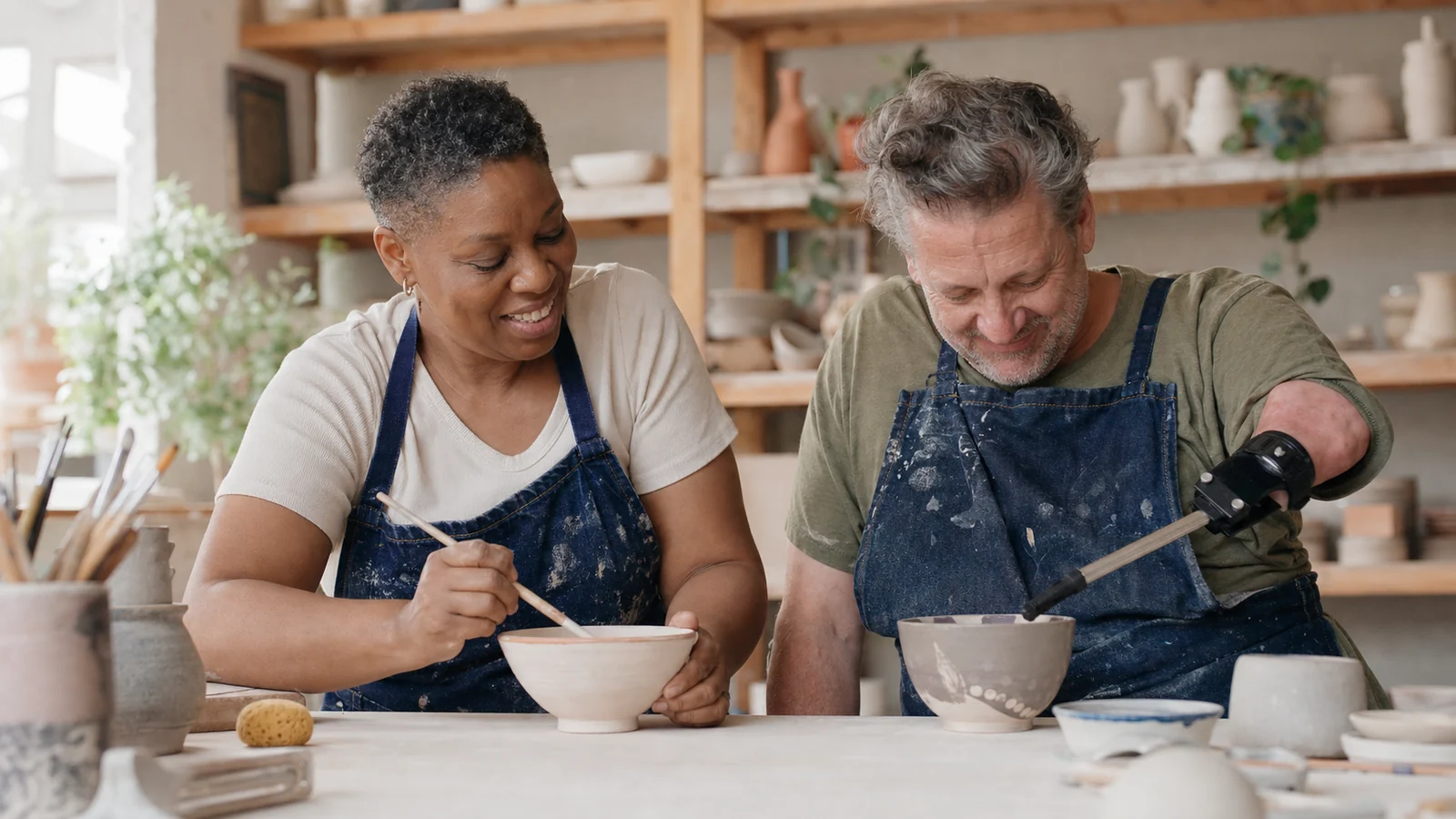
Start with the shared purpose: talk, make something, enjoy music, explore a place or laugh together. Then remove barriers. A ceramics studio with adaptive tools, a quiet food tasting, an audio-described or captioned performance, a level garden, an accessible games café or an online creative session can all feel intentional.
Run the COMPLETE check
- Communication: How will details and changes be shared?
- Location: Is the full route usable, including transport and toilets?
- Options: Is there a lower-demand alternative?
- Meeting point: Is it precise and easy to identify?
- Pace: Are breaks and an end time built in?
- Light, sound and scent: Does the environment suit both people?
- Assistance: What is welcome, and what is not?
- Travel home: Can each person leave independently?
Do not promise access based on a venue icon. Contact staff with concrete questions and share the answer. If access fails, apologise for the barrier, use the alternative and raise the problem with the venue later—not in a way that makes the disabled person perform gratitude.
Respect intersecting identities and adult autonomy
Disability exists alongside race, gender, sexuality, age, religion, class and culture. A disabled LGBTQ+ person may be deciding which identity to disclose first. A person who relies on family support may navigate cultural expectations around privacy. An older disabled adult may face assumptions that they are not sexual. Listen for the whole context.
Learning disability does not erase adulthood
Adults with learning disabilities can want romance, sex and partnership. Use accessible language, check understanding and respect consent. Do not speak only to a support person. Capacity is decision-specific and should not be judged by speech style, reading level or the presence of assistance.
Support should increase choice
A support person can help with transport, communication or safety if the disabled adult wants them involved. They should not dominate the date, share private information or make relationship decisions on the person’s behalf.
Speech differences require patience, not completion
Give time, reduce background noise and ask how to repair missed words. Do not pretend to understand; say which part you caught. Avoid finishing sentences unless invited. A communication device is the person’s voice—wait while they use it and respond to them, not the device.
Grow an equal relationship with changing needs
Equality is not sameness. Partners contribute different resources at different times: physical tasks, money, planning, emotional steadiness, creativity, advocacy or care. Discuss who does what before assumptions harden. Revisit the arrangement after health, work or support changes.
Keep romance outside the care dynamic
If practical help enters the relationship, define it. Which tasks are welcome? Which belong to paid support? How can either person say no? Schedule time where disability logistics are not the topic. Desire and play need attention too.
Plan conflict accessibly
Agree whether difficult conversations work best in writing, in person, with breaks or with communication support. Do not withhold aids, block exits, remove devices or use personal-care needs as leverage. Those behaviours are abuse, regardless of stress.
Keep friends, private communication and independent access to money and documents. Early in dating, meet publicly and verify identity. The FTC advises never sending money or gifts to an online romantic interest you have not met; its romance scam guidance describes common warning signs.
Inclusive disability dating is not achieved by memorising a rule for every condition. It comes from a repeatable practice: start with the person, ask about the current situation, remove the barrier you can, respect a no, protect private information and notice whether care flows both ways. Explore our disabled dating communities to find guidance closer to your experience.
When you are unsure, slow down and ask. A respectful correction is not a failed date; it is evidence that two people can learn together. The standard is not perfect knowledge. It is whether both people retain dignity, choice and room to enjoy each other.
Inclusive Disability Dating FAQ
What if my disability does not fit one dating category?
Describe the preferences and access needs that matter to you. A broad label is optional; your own instructions are more useful than a category.
How much disability information belongs in a profile?
Share enough to feel authentic and support your goals, but keep medical documents, addresses, finances and detailed care routines private.
How do I ask about access without being intrusive?
Ask a narrow functional question about the plan, such as seating, communication or transport. Do not demand the medical reason.
Can a support person attend a date?
Yes, if the disabled adult wants that support. Agree on the person's role, privacy and how the couple will have direct conversation.
What makes a relationship equal when support needs differ?
Mutual agency, agreed contributions, boundaries around care and regular conversations matter more than identical tasks each day.
This guide offers general dating and access-planning information, not medical or legal advice. Individual needs differ; ask the person and respect their answer.
Meet People Who Value the Whole You
Build a profile around your interests, values and relationship goals, with control over what personal information you share.
Create Your Free Profile