Quick answer
Disabled dating in the United States works best when people lead with personality and verify practical access before meeting. A useful profile gives specific conversation starters, states a relationship goal and lets each person decide when to discuss disability, health or neurodivergence.
For an in-person date, check the entire route—not only the front door—then agree on timing, transport and a backup. Keep money, home details and care routines private while trust develops. Good planning should make room for romance, not replace it.
Dating across the United States can feel abundant and complicated at the same time. A large population creates more possibilities, yet the useful pool changes quickly by city size, transportation, time zone and how far someone can comfortably travel. A person in New York may plan around elevators and crowds; someone in a small Midwestern town may need a longer drive; a couple in Arizona may treat heat as an access issue. There is no single American disabled dating experience.
The common ground is practical. Attraction grows through humor, shared values and repeated attention. Accessibility supports those things by removing preventable friction. It should never reduce a date to a checklist of diagnoses or turn one person into the other's case manager.
Understand the U.S. disabled dating landscape
Location affects who appears in a local search and what meeting in person requires. Major metropolitan areas may offer larger communities, accessible transit and more venue choices, but they can also bring crowded stations, broken elevators and expensive parking. Suburban and rural areas may provide quieter places and easier parking while increasing travel time and dependence on a car.
Start by choosing a realistic radius. If a two-hour trip would be exhausting or costly every weekend, do not present it as easy during the first conversation. A smaller radius can produce fewer profiles but better follow-through. If you are open to long-distance dating, say what that means: occasional weekend visits, relocation after a serious commitment, or online conversation until both people can plan a safe trip.
Accessibility labels are a starting point, not a guarantee
In the United States, Title III of the Americans with Disabilities Act covers many businesses and nonprofit service providers that are public accommodations. The U.S. Department of Justice provides an official overview of Title III. Even so, a general label cannot tell you whether a particular table, restroom, captioning setup or sensory environment works for a particular person. Older buildings, temporary equipment failures and incomplete listings make direct confirmation worthwhile.
This page provides dating and planning information, not legal advice. If a barrier raises a legal question, use an official government source or a qualified local adviser.
Create a profile that gives someone a reason to reply
A strong disabled dating profile in the United States should sound like a person, not a résumé or medical intake form. Specific details create easy openings. “I drive an hour for good barbecue and know the quietest lake trail in the county” is easier to answer than “I like food and nature.” Include what your week actually contains and what kind of relationship you want to build.
Use three layers of information
- Personality: name a habit, opinion or small pleasure that feels recognizably yours.
- Lifestyle: show your pace, favorite activities and how you usually spend free time.
- Intention: state whether you want a committed relationship, companionship or a slower introduction without demanding an immediate promise.
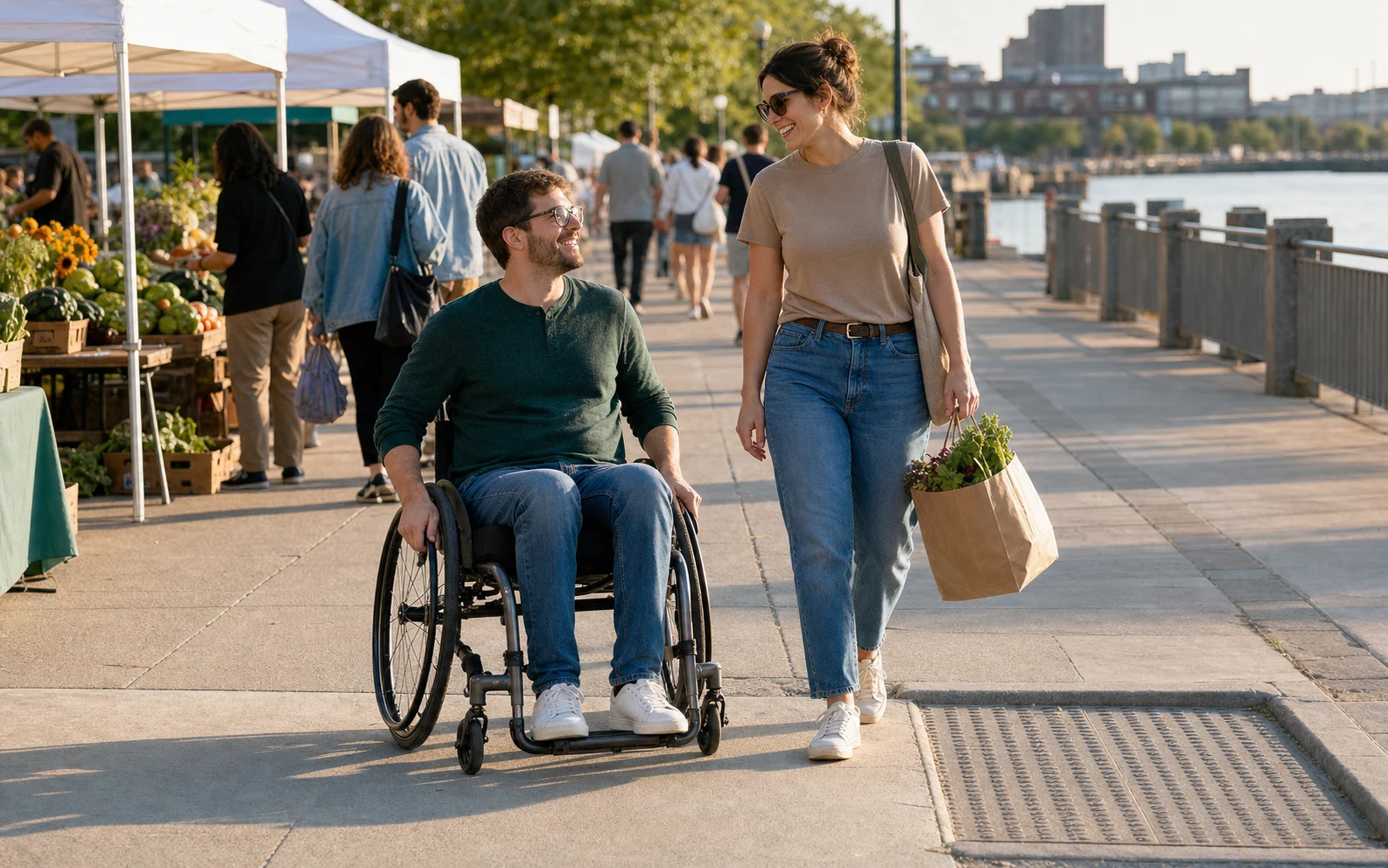
Disability can appear in any layer, but it does not need to dominate. You might show a wheelchair, service dog, cane, hearing device or prosthesis in a photo because it is part of daily life. You might mention chronic illness when explaining that shorter dates suit your energy. You might wait until a conversation feels promising. All are legitimate choices.
A profile sentence that balances warmth and logistics
Try: “Most weekends include live jazz, a level park route and an ambitious breakfast; I use a power chair, so accurate venue information wins points.” It shares personality, an access detail and a playful invitation without asking a stranger to process a medical history. Our authentic dating profile guide offers more examples.
Verify real accessibility before the first date
Ask the person what matters, then call the venue with concrete questions. “Are you accessible?” often produces an automatic yes. “Is there a step between the sidewalk and entrance, and is the door at least wide enough for a power chair?” produces usable information. For sensory, communication or cognitive access, ask about lighting, noise, captioning, seating away from speakers, menus in accessible formats and the possibility of a quieter time.
| Part of the date | What to confirm | Helpful backup |
|---|---|---|
| Arrival | Accessible parking or paratransit drop-off, curb cuts, surface and distance to the entrance | A second entrance or nearby level meeting point |
| Entry | Steps, ramp slope, door weight, lift dimensions and whether equipment is working | A nearby venue with a verified level entrance |
| Inside | Aisle width, movable chairs, table height, lighting and background sound | Patio or quiet corner confirmed in advance |
| Communication | Captioned media, staff communication, menu format and reliable mobile signal | Downloaded menu, notes app or personal communication method |
| Restroom | Location, route, transfer space and whether it is clear of storage | Know another nearby facility before meeting |
Send the result in one calm message: “I checked the entrance, restroom and table space. The front door is level, and they can reserve the quieter table at 6:00. Does that setup work for you?” This shows care without assuming you understand every need.
Choose accessible date ideas that leave room to connect
The best first dates have a natural conversation focus, a manageable duration and a graceful way to extend or finish. Across the U.S., possibilities include a museum during a quieter hour, a paved waterfront walk, an accessible food hall, a minor-league game with confirmed seating, a library event, adaptive recreation, a botanical garden, a comedy show with captioning, or coffee near reliable transport.
Climate changes the plan. Heat can affect fatigue, medication, dysautonomia, prosthetic comfort or wheelchair batteries. Cold can reduce dexterity and make snow-covered curb cuts unusable. Storms can interrupt electricity or transportation. Check the forecast and describe Plan B before the date, not after one person has already traveled.
Keep the first meeting deliberately simple
- Offer two choices rather than making one person do all the research.
- Agree on a visible, level meeting point instead of “somewhere near the entrance.”
- Start with 60 to 90 minutes and allow the date to continue only if both want it.
- Let each person control their transportation home.
- Do not touch mobility equipment, guide a blind person or interpret for a Deaf person without asking.
Our accessible first-date planning guide includes messages you can adapt for venues, timing and backup plans.
Handle state lines, time zones and travel honestly
Long-distance disabled dating can work, but enthusiasm should not hide the cost. Before booking a trip, video chat, discuss expectations and confirm that the visitor can use the accommodation, local transportation and planned venues. Do not assume an “ADA room” has the bed height, shower setup or turning space someone needs; ask the hotel for measurements and photographs where possible.
Time zones also affect communication. A recurring call at 8:00 p.m. Eastern is 5:00 p.m. Pacific, which may overlap with work, medication, care or commuting. Set a rhythm that respects energy as well as the clock. Alternating who travels can feel fair, but equality is not always identical effort. Cost, fatigue and assistance may make a different arrangement more sustainable.
Protect privacy and safety as trust develops
Romance scammers often create urgency, isolation and a story that ends in a money request. The Federal Trade Commission advises people not to send money or gifts to a romantic interest they have not met in person; review its romance scam guidance. Disability-related stories about equipment, treatment, benefits or transport do not make a request safer.
- Keep your exact home address, financial details, identification and care schedule private early on.
- Stay on the platform while you assess consistency and boundaries.
- Use a video conversation before traveling a long distance.
- Meet in a public place, share the plan with a trusted person and set a check-in time.
- Save messages and use block or report tools when behavior becomes coercive.
Someone who respects you will also respect “not yet,” a shorter date, a change of venue or your decision to end contact. Read AbleMatchup's dating safety guidance before an in-person meeting.
Build a relationship around reciprocity, not assumptions
As closeness grows, couples often share practical work. One person may drive while the other researches accessible venues; one may help with a difficult door while the other handles bookings. Support should be discussed, not silently assigned. A partner is not automatically a caregiver, translator, driver or advocate.
Ask what assistance is welcome and notice how both people contribute. Keep dates that are simply enjoyable, without every conversation becoming about health or access. Intimacy also benefits from direct questions about comfort, positioning, communication and consent. An assistive device does not reveal someone's sexual interests or capacity.
Disabled dating in the United States becomes more workable when people replace broad assumptions with specific information. Be honest about distance, verify the route, protect private details and stay curious about the whole person. The result can feel wonderfully ordinary: two people deciding whether conversation should become another date.
United States Disabled Dating FAQ
Where can disabled singles meet in the United States?
Online communities can broaden the pool beyond one neighborhood, while accessible interest groups, adaptive recreation, volunteering and community events create natural ways to meet. Choose spaces that fit your interests rather than attending only because they are disability-related.
How do I check whether a U.S. first-date venue is accessible?
Call the venue and ask about the complete route from parking or transit to the entrance, interior, seating and restroom. Describe the feature you need instead of relying only on an accessible label, and keep a nearby backup option.
Do I have to disclose a disability in my dating profile?
No. You can mention it, show an assistive device in photos, discuss it later or keep medical details private. Share enough for safe planning when a meeting becomes likely, but choose your own timing.
What is a good accessible first date in the U.S.?
A level coffee shop, accessible museum, paved botanical garden, waterfront trail, adaptive activity or short video date can work. The best choice combines a shared interest with verified access, manageable timing and an easy exit for both people.
How can I stay safer when dating online?
Keep financial and identifying information private, use the platform's communication tools while trust develops, video chat before a long trip, meet in public, arrange your own transportation and never send money to an online romantic interest.
This guide offers general dating, safety and access-planning information. It is not medical or legal advice. Services, laws and individual needs vary by location; verify current details with official sources and the person involved.
Meet People Who Value the Whole You
Create a profile around your interests, values and relationship goals, with control over what personal information you share.
Create Your Free Profile