Quick answer
Disabled dating in the UK is easier when a first meeting is built around a shared interest and the complete journey is checked in advance. Ask about the feature that matters—step-free entry, lift size, a quiet table, captions, seating or toilet access—rather than trusting a broad venue label.
Keep the conversation personal: interests first, access when useful, medical history only by choice. Agree on timing and transport, have a nearby alternative, protect private information and let each person decide what independence and support look like.
The UK can feel compact on a map, but dating from a London borough, a Scottish island, a Welsh valley or a market town creates very different choices. Public transport can widen the dating radius; missed connections, lift outages, cobbles and the last train home can narrow it again. Useful advice must account for the journey as well as the venue.
Good disabled dating is not defined by perfect access or perfect language. It grows when two people pay attention, exchange clear information and remain willing to adjust. Disability may affect the plan, but it should not become the whole subject of the date.
Plan around local reality, not an ideal map
Begin with a radius you can sustain. Forty miles may be straightforward by car and extremely difficult by two trains and a replacement bus. Think about the return journey, energy after the date, assistance hours, medication, parking and whether travel remains available if the meeting runs late. If regular visits would be hard, say so before a promising conversation becomes an unspoken commitment.
City centres often have more venue choice but bring crowds, noise and older buildings. Smaller places may offer quiet and familiar routes while providing fewer accessible options. Neither is automatically better. A date works when the actual environment fits the two people meeting.
Choose an exact meeting point
“Outside the station” can mean four exits, a busy concourse and a broken lift. Name a level, well-lit landmark that both people can reach independently. Share what you are wearing and send a message when you arrive. If one person is blind or has low vision, describe your location rather than waving. If someone is Deaf, do not rely on a station announcement as the only update.
Write a profile and opening message that sound human
A memorable UK disabled dating profile offers details that invite a reply: the Sunday roast you defend, a local walk with a reliable surface, a band you have seen too many times, or the museum room you always visit first. “Kind, loyal, likes travel” is pleasant but hard to answer. Specificity creates momentum.
State your relationship intention in ordinary language. “I would like a steady relationship, but I am happy to let trust build” is clear without sounding like a deadline. If disability or access appears, connect it to life rather than presenting a list: “I use crutches and favour plans with seating; my knowledge of small cinemas is excellent.”
Better opening questions
- “You mentioned coastal weekends. Which place is worth the train journey?”
- “Your profile says you cook. What is your reliable dinner when the week has been long?”
- “I would enjoy meeting. Would a quiet café or an accessible gallery suit you better?”
- “I can check the venue details. What features matter most for you?”
These questions show attention without making disability the price of entry into the conversation. For a fuller profile framework, read how to write an authentic dating profile.
Understand access and reasonable adjustments without making legal claims
The Equality Act 2010 is a central part of disability discrimination law in Great Britain. Current official guidance and legislation explain duties related to services and reasonable adjustments; Northern Ireland has a different legal framework. The Equality Act 2010 is available on legislation.gov.uk, and GOV.UK publishes a 2026 services code of practice publication.
That context can be useful, but a first date is not the moment to guess legal compliance. Confirm the features that make the plan usable. This guide is general information, not legal advice.
| Listing phrase | Question to ask | Detail people often miss |
|---|---|---|
| Step-free | Is the route level, ramped or lift-served from pavement to table? | Gradient, cobbles, thresholds and door weight |
| Accessible toilet | Where is it, how is it reached and is it available to customers? | Storage, a Radar key, transfer space and alarm cord |
| Hearing loop | Where does it work, and have staff tested it today? | A loop may cover only one counter or room |
| Relaxed performance | What changes to sound, light, movement and re-entry are included? | The format varies between venues |
| Assistance dogs welcome | Where can the dog settle, and is water available? | A cramped table can still be impractical |
Make the whole outward and return journey work
For rail travel, check the station, platform changes, interchange time and lift status rather than only whether the train is accessible. Assistance arrangements may help, but a plan should still account for disruption. Save the venue's phone number and know the final accessible route from the station. If a taxi is the backup, confirm that a suitable vehicle is actually available in that area and at the needed time.
Driving brings its own details: Blue Badge bays, height restrictions, drop-off space, road closures and how far the car park is from the entrance. A pub may have an accessible front door but only a gravel overflow car park. Rain, ice and early winter darkness can alter a route that works in summer.
A message that shares the planning load
“The museum has a level entrance, lifts to every gallery and seating in the café. The station lift is currently listed as working, and there is a bus from the next station if that changes. Would that journey work for you?” The message supplies evidence and still leaves the expert—the person using the route—to decide.
Accessible first-date ideas across the UK
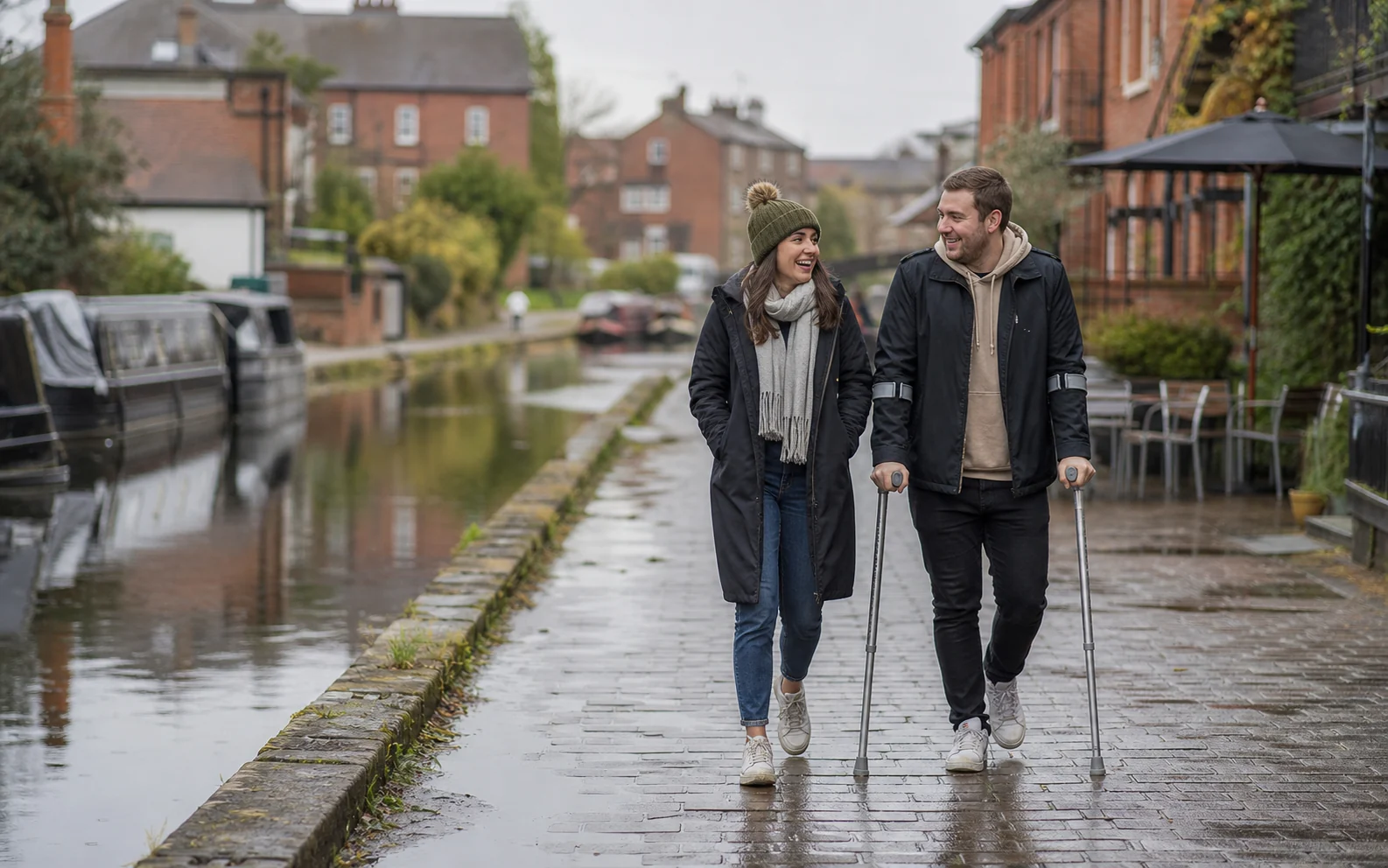
A good activity should allow conversation without demanding constant eye contact or physical stamina. Consider a museum during a quieter weekday hour, a level botanical garden route, a café with spaced tables, a food market with dependable seating, an accessible theatre performance, a pottery workshop, a paved canal section, a library talk or a short online date before a longer journey.
Historic does not necessarily mean inaccessible, and modern does not guarantee access. Use the venue's access guide, then telephone for any detail that determines whether the outing works. User photographs can reveal surfaces and thresholds, but they may be old. Ask when the information was last checked.
Build a weather-proof Plan B
A promising walk can become tiring or unsafe in heavy rain. Place an accessible indoor option close to the original plan, not across town. If heat, cold, fatigue or sensory overload changes the date, respond without disappointment: “No problem; we can move inside or finish here.” A flexible ending makes a second meeting more likely than pushing through discomfort.
Discuss communication, disability and help at the right pace
Some people want to explain a diagnosis early; others prefer to share only functional information. “I need a seat while we wait” is complete even without a medical reason. Do not pressure someone to provide proof, prognosis or a story that satisfies curiosity.
If a date uses sign language, speech-to-text, a communication device or a support person, speak directly to your date. Face them, keep your mouth visible when lipreading matters and ask which method works. RNID provides practical communication tips for Deaf people and people with hearing loss. Individual preferences still come first.
Offer assistance once, specifically, and accept the answer. “Would you like me to carry the tray?” is better than taking it. Mobility aids, guide-dog harnesses and communication devices belong to the person; do not touch or move them without permission.
Keep early dating safe without making it fearful
- Use the platform until you are comfortable sharing a phone number or social account.
- Keep your address, financial information, care arrangements and identification private.
- Meet in public and tell a trusted person the venue, time and expected return.
- Arrange an independent journey home and keep enough battery or credit for changes.
- End contact if someone ignores access needs, sexual boundaries or repeated refusals.
Money requests, urgent crises, refusal to video chat and pressure to leave a platform deserve caution. Never let affection turn into financial responsibility for someone you have not met. AbleMatchup's dating safety page offers a practical pre-date review.
Disabled dating in the UK is most enjoyable when information serves the relationship. Check the route, then talk about music. Reserve the quiet table, then debate dessert. Respect access needs without treating them as the most interesting thing about your date.
United Kingdom Disabled Dating FAQ
What is a good first date for a disabled person in the UK?
Choose a shared interest and verify the full journey. A quiet café, accessible museum, paved garden, relaxed pub meal, captioned performance or short video date can work when the entrance, interior, toilet, transport and timing suit both people.
Does step-free always mean fully accessible?
No. A step-free route may still involve a steep slope, long distance, narrow lift, heavy door, cobbles or an inaccessible toilet. Ask for details that match the individual rather than relying on one label.
When should I talk about disability while dating?
There is no required timetable. Share when it helps you feel known, supports safe planning or feels right in the relationship. You can discuss functional needs without giving a diagnosis or full medical history.
How can I plan a date using UK public transport?
Check the entire outward and return journey, including station access, interchange time, lift status and the final route to the venue. Confirm assistance if needed and keep a taxi, bus or nearby venue as a backup.
How do I respond if a venue has an unexpected barrier?
Believe your date, avoid debating whether the venue should count as accessible, and use the backup. Later, you can give the venue clear feedback or use an appropriate complaint process if the affected person wants to.
This guide offers general dating, safety and access-planning information. It is not medical or legal advice. Services, laws and individual needs vary by location; verify current details with official sources and the person involved.
Meet People Who Value the Whole You
Create a profile around your interests, values and relationship goals, with control over what personal information you share.
Create Your Free Profile