Quick answer
Disabled dating in Canada becomes more manageable when people are honest about distance and plan for the actual season. Create a profile that shows local life and relationship goals, then discuss only the access details needed for a safe, comfortable meeting.
Before a first date, confirm transport, snow clearance or surface conditions, entrance, seating, communication and the journey home. A flexible backup and an independent exit protect both comfort and confidence, especially when people are travelling between communities.
Canada's size shapes dating in ways a city-based app radius cannot fully explain. Twenty kilometres in central Toronto, rural Saskatchewan, coastal British Columbia or northern Quebec can represent completely different journeys. Weather, ferries, highways, paratransit schedules and time zones affect whether an online connection can become a repeatable relationship.
That practical reality does not make disabled dating in Canada less hopeful. It simply rewards clarity. When two people discuss distance, access and energy early enough, logistics become a shared problem rather than a late surprise.
Let geography shape the plan—not the value of the connection
Choose a dating radius based on the journey you can repeat, not the largest number of profiles you can see. A first visit may feel exciting enough to justify a long drive, but a relationship needs a sustainable pattern. Consider fuel or fares, accessible vehicles, rest stops, personal assistance, work schedules and recovery time after travel.
When a promising match lives farther away, begin with shorter video calls at different times of day. This reveals communication rhythm without forcing either person to spend money. If you decide to meet, agree on who travels, where they will stay, what the visit means and how either person can change the plan.
Long-distance effort should be fair, not mechanically equal
Alternating every trip sounds balanced, but access may make one route far more difficult. One partner might travel less often and contribute by arranging accommodation, paying part of a fare or planning accessible activities. Reciprocity means both people are considered and both contribute; it does not require identical tasks.
Write a profile with enough local context to be useful
A Canadian disabled dating profile benefits from specific place-based clues. Mention whether your ideal Saturday is a neighbourhood café, a hockey game, a lakeside route, a bookshop or a quiet evening cooking. If you are willing to cross a provincial border or eventually relocate, explain that without promising more than you know.
Use current photographs that show more than one setting. An assistive device can appear naturally if it is part of your life, but you choose how much disability information belongs in the text. A diagnosis rarely tells someone exactly what a date requires. Functional information is often more useful: “My energy is best in the afternoon,” “I need captions for video,” or “I use a chair and travel in an adapted van.”
A practical three-line profile structure
- Life: one sentence about how you genuinely spend your time.
- Connection: one sentence about the relationship you hope to build.
- Invitation: one easy question or detail a compatible person can answer.
Example: “I split weekends between community theatre and the quietest waterfront path I can find. I would like a grounded relationship with room for humour and independence. Tell me which meal you make when you want someone to stay for seconds.” The AbleMatchup profile guide provides a longer worksheet.
Treat winter as part of accessibility planning
Snow and ice can turn a technically accessible route into an unusable one. A ploughed car park does not guarantee a cleared curb cut; a cleared entrance does not guarantee a safe path from the bus stop. Cold can affect batteries, pain, circulation, dexterity, respiratory conditions and some prosthetic components. Ask what matters rather than assuming everyone experiences winter in the same way.
| Risk | Confirm before leaving | Low-pressure alternative |
|---|---|---|
| Snow or ice | Sidewalk, curb cut, ramp and accessible parking have been cleared | Move to a connected indoor venue or reschedule without blame |
| Extreme cold | Waiting time is short and the entrance has an indoor vestibule | Meet by video with the same meal or activity |
| Transit disruption | Lift status, paratransit window and return service are current | Choose a venue closer to the person with fewer options |
| Wet equipment | There is room for coats, mobility aids and safe transfers | Reserve a spacious table away from the doorway |
| Fatigue | The date can remain short and seating is available immediately | Plan a second meeting instead of extending the first |
Weather changes are not a test of commitment. If someone cancels because the route is unsafe, respond with care rather than suspicion. A simple “Thanks for telling me; let's use our backup” builds trust.
Use accessible service principles as a planning lens
The Accessible Canada Act aims to identify, remove and prevent barriers in areas under federal jurisdiction, with a goal of a barrier-free Canada by 2040. The Government of Canada provides an official summary of the Accessible Canada Act. It does not cover every restaurant, venue or local service; provincial and territorial rules also matter.
Accessibility Standards Canada describes accessible service in terms that include dignity, independence and equal opportunity. Its accessible service delivery standard is aimed at organizations, but the principles are useful for date planning too: provide information in a usable way, respect the person's choices and avoid unnecessary dependence.
This guide does not offer legal advice. For a specific complaint or right, consult the responsible federal, provincial or territorial body.
Ask venues about the full experience
- Is the route level from transit, parking or drop-off to the entrance?
- Are doors, lifts and accessible toilets available and operating today?
- Can staff reserve a table with appropriate clearance and lighting?
- Are captions, a hearing system, large print or another communication option available?
- Is there a lower-sensory time, quiet room or permission to step out and return?
Share the answers, then ask if anything else matters. Do not present the research as proof that the person must accept the plan.
Respect language, culture and individual communication
Canada is officially bilingual at the federal level, while everyday language use differs across provinces, territories and communities. Do not assume a person prefers English because their profile is written in English, or that every Deaf person uses the same signed language. Ask which spoken, signed, written or assistive method works.
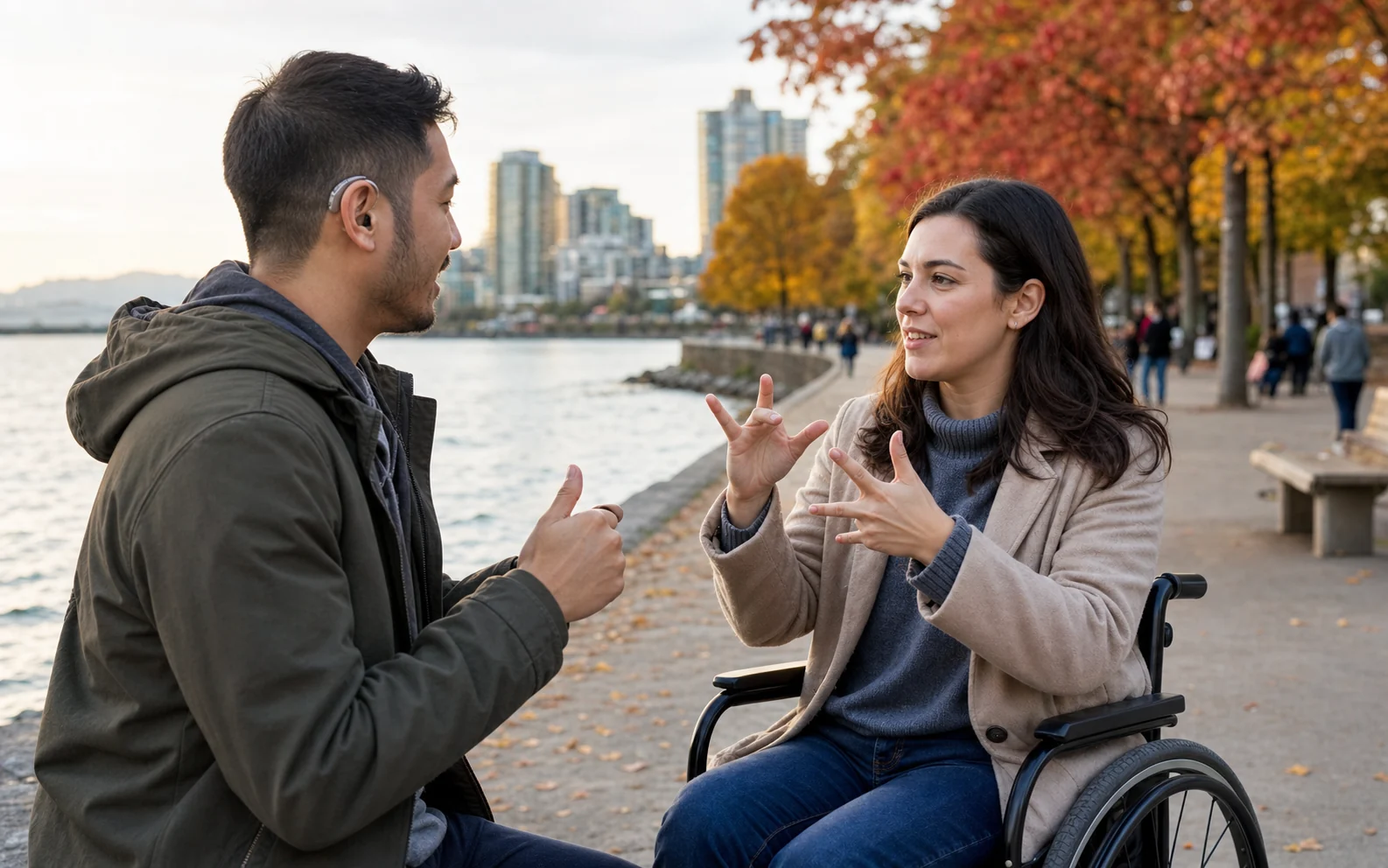
For a Deaf or hard-of-hearing date, good light and a quieter table can be more useful than speaking louder. Face the person, avoid covering your mouth if lipreading matters and use captions or text when requested. Speak directly to your date when an interpreter is present. For blind or low-vision dates, identify yourself, describe relevant surroundings and offer an elbow only after asking. For autistic or cognitively disabled dates, clear timing and literal information may reduce uncertainty, but preferences remain individual.
Disclosure can be functional without being clinical
- “Busy rooms drain my energy, so could we choose the quieter seating?”
- “I use captions for video calls. Would you mind turning them on?”
- “I can meet for about an hour the first time, and I will let you know if I have energy to stay.”
- “I am comfortable discussing access now; I prefer to keep medical detail private until we know each other better.”
A respectful person responds to the need rather than demanding a diagnosis to justify it.
Design the first meeting around a shared interest
Accessible date ideas in Canada include a quiet café near reliable transit, a museum with a detailed access guide, an indoor botanical space, a paved waterfront route, a relaxed food hall, an adaptive recreation session, a library programme, a captioned film or an online cooking date. Confirm the specific location; chains and municipal facilities can differ from site to site.
Plan 60 to 90 minutes with an obvious option to extend. Set an exact level meeting point. Each person should have money, a charged phone and an independent route home. If paratransit requires a pickup window, build that into the plan without treating it as an inconvenience.
For detailed venue questions and backup messages, use our accessible first-date planning resource.
Protect trust, privacy and equality
During early conversation, keep your exact address, identification, banking details, benefits information and care schedule private. Video chat before a long journey, meet in public and tell a trusted person where you are going. Never send money to someone who creates a romantic emergency. Pressure, isolation, inconsistent stories and refusal to respect “no” matter more than how convincing a profile looks.
As the relationship develops, talk about help rather than assigning roles. A partner is not automatically a caregiver, driver or interpreter. One person may assist with winter equipment while the other handles route research; both should have agency and time that is simply romantic.
Canada's distances and seasons require more planning, but they can also encourage honest communication early. When people are clear about what is possible, verify access and make room for changing energy, disabled dating can become what it should be: a chance to know another person in full.
Canada Disabled Dating FAQ
How can disabled singles date across long distances in Canada?
Set a realistic radius, talk openly about travel cost and energy, use video calls before booking, alternate effort in a sustainable way and verify transport, accommodation and venue access for every visit.
What makes a good accessible winter date in Canada?
Choose an indoor venue near reliable transport, confirm that snow is cleared from the drop-off route and entrance, allow extra time, and keep a weather-proof backup such as a video dinner or a closer café.
Does the Accessible Canada Act cover every dating venue?
No. The Act focuses on areas under federal jurisdiction. Provinces and territories have their own laws, standards and services, so use the rules and official guidance relevant to the specific place. This page is not legal advice.
Should I disclose an invisible disability before meeting?
You decide. Share a functional need when it helps the plan, such as requiring a quiet table or shorter date, without feeling required to provide a diagnosis. More detail can come as trust grows.
How do I communicate respectfully with a Deaf date in Canada?
Ask which method they prefer, face them in good light, keep your hands and face visible, reduce background noise and speak directly to them. Do not assume every Deaf person uses the same sign language or communication method.
This guide offers general dating, safety and access-planning information. It is not medical or legal advice. Services, laws and individual needs vary by location; verify current details with official sources and the person involved.
Meet People Who Value the Whole You
Create a profile around your interests, values and relationship goals, with control over what personal information you share.
Create Your Free Profile