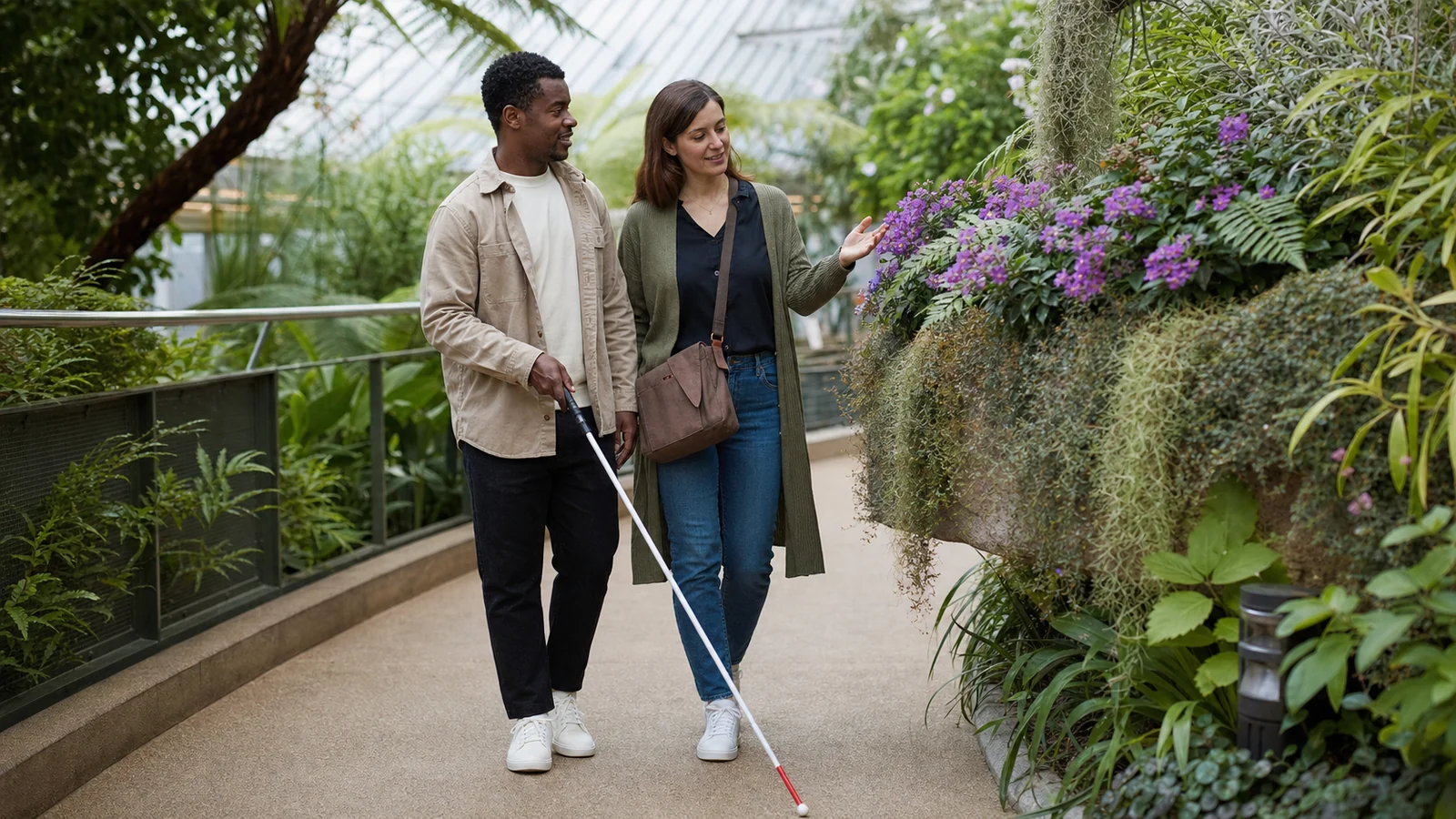
For blind and low-vision people, online dating is not inaccessible by definition. The quality of the experience depends on whether the platform works with screen readers and keyboards, whether profiles communicate more than photographs, and whether potential partners understand that offering useful information is different from taking control. Blind dating should leave room for attraction, humour and autonomy—not a running test of independence.
What makes a date accessible?
Use clear profile text and useful image descriptions. Before meeting, describe the entrance and meeting point precisely, share any route changes, and ask what assistance is wanted. Introduce yourself by name, speak directly to the blind person, and never grab, steer, move a cane or distract a guide dog.
Create an accessible online dating profile
Photographs can convey style and personality, but they should not carry every important fact. A profile that says “travel lover, music fan, easy-going” gives little to anyone. Replace broad labels with scenes: “I make overcomplicated Sunday breakfasts, collect live jazz recordings and know the best spicy noodles near the station.” Specific language creates a mental picture and an easy first message.
Describe images for meaning, not every pixel
Good alternative text identifies the person, setting, expression and relevant action: “Maya smiling in a red raincoat beside a windy beach” is useful. “Image123” is not. Avoid stuffing an alt description with appearance judgments that are not visible facts. If a platform does not expose alt text, add a short photo note in the profile.
The Web Content Accessibility Guidelines explain that accessible digital content supports people with a wide range of disabilities. Keyboard operation, meaningful labels and text alternatives are foundational. The W3C WCAG overview is a useful reference for platforms and content creators.
| Vague | More useful | Why it works |
|---|---|---|
| “I love music.” | “I play soul records while cooking and never skip a small live venue.” | Provides sound, setting and a conversation route. |
| “Here for adventures.” | “My ideal Saturday is a train trip, an audio tour and lunch somewhere local.” | Shows pace and activity preference. |
| “Funny and kind.” | “I send terrible puns and always remember how you take your tea.” | Demonstrates qualities through behaviour. |
| Photo only | “Full-length photo: navy suit, white cane, laughing outside a theatre.” | Makes the image meaningful to nonvisual users. |
Communicate attraction beyond visual shorthand
Visual compliments are welcome when sincere, but attraction can be expressed through voice, timing, humour, warmth, scent, conversation and presence. Instead of repeatedly asking whether a blind date can “picture” something, describe what matters: the room is bright and crowded; the waiter placed drinks near the table edge; the sunset has turned the clouds deep orange.
Use precise language for plans
“Meet by the entrance” can be useless when a building has three doors. Say, “I’ll be outside the step-free east entrance, beside the taxi rank, wearing a green jacket. I’ll say your name when I see you.” Send the venue name, full address and booking name in text so it can be retrieved by a screen reader.
Voice notes can add personality, but do not assume they are always preferred; someone may be in a noisy environment or want searchable written details. Ask whether text, audio or calls work best. Accessible communication is about options.
Plan a first meeting that supports orientation
Choose a public venue with a simple layout and staff who can describe access. A blind person may travel independently with a cane, guide dog, phone navigation, sighted guide or a combination. Do not insist on collecting them from home. That may reveal an address too soon and remove control over departure.
Before the date
- Confirm the exact entrance and whether temporary construction affects the route.
- Reserve a table away from narrow traffic lanes and very loud speakers.
- Explain changes promptly rather than waiting until arrival.
- Agree how you will recognise each other; the sighted person should introduce themselves.
- Keep the first plan compact, with an easy extension if conversation is good.
Inside, mention relevant obstacles without narrating every movement: “There are three steps down in about two metres, with a rail on the right.” Ask whether more detail is useful. If food arrives, offer a clock-face description only if the person wants it. Independence does not mean refusing information; it means controlling how information is used.
Offer help without grabbing or steering
Never take someone’s arm, cane or guide-dog harness without permission. If guiding is requested, offer your elbow and walk half a step ahead at a natural pace. Mention stairs, narrow spaces and door direction. At a seat, guide the person’s hand to the back of the chair if they agree, then let them sit independently.
- “Would you like my elbow, verbal directions, or neither?”
- “There’s a chair directly behind your right hand; may I place your hand on the back?”
- “The route ahead is crowded. Would you like more detail?”
- “I moved your glass closer to the centre of the table; it is at two o’clock.”
Guide dogs are working
Do not pet, feed, call or make eye contact with a guide dog while it is working. Speak to the handler, not the dog. Keep your own pet under control and do not take the harness. If the dog settles under a table, leave enough space and tell staff not to distract it. The handler will explain if interaction is welcome later.
Do not move belongings without saying so. A cane, phone, bag or glass placed deliberately helps someone map the space. Silent “tidying” can make an item disappear.
First-date ideas for blind and low-vision people
Start with the person's interests, then make the experience easy to enter, enjoy and leave. A date can include art, a film or a view; ask what description or access would help instead of assuming a visual activity is off limits. Food tasting, live acoustic music, a museum with touch objects, an adapted dance class, a cooking session, audio-described theatre or a familiar park route can all leave plenty of room for chemistry.
| Plan | Why it can work | Check together |
|---|---|---|
| Quiet café and short walk | Conversation comes first; the walk is optional. | Exact entrance, clear meeting point, crossing points and a seated backup. |
| Audio-described theatre or cinema | Shared story gives you something to discuss afterwards. | Whether description is available for that performance, how to collect equipment and a reachable seat. |
| Tactile tour or museum visit | Exploring objects together creates natural conversation. | Which exhibits can be touched, whether a guide is booked and how to navigate between rooms. |
| Cooking class or food tasting | Hands-on activity can feel playful without relying on visual cues. | Instructions in an accessible format, work surface layout, food needs and whether staff can orient participants. |
Send the venue name, full address and exact meeting point in text ahead of time. If a guide dog is coming, ask about space and the route through the venue. Both people should know how to leave independently; a shorter plan with the option to extend usually feels more relaxed than an all-day itinerary.
Ask the venue three questions
Is audio description or a tactile tour available? Can staff orient a visitor to the room and facilities? Are menus and booking information accessible digitally? Confirm the answer with a staff member, because a logo on a listing may not reflect current service.
Avoid assuming that visual arts, cinema or travel are uninteresting. Many blind people enjoy them with description, touch, sound or personal methods. Ask what the person likes before reducing the activity list.
Balance independence, privacy and dating safety
Blind people sometimes face patronising behaviour that can hide control. A date who insists on handling money, orders without asking, withholds location information or prevents independent travel is not being protective. Support should increase choice.
For a first meeting, use a public place, tell someone where you are going, keep your phone charged and arrange your own transport. Save the venue address and route before leaving. Consider a check-in word with a friend. Do not disclose financial accounts, disability documents or home details early.
Digital accessibility is also a safety feature
Buttons need clear labels, error messages must be readable, and all controls should work from a keyboard. W3C notes that people who cannot use a mouse may rely on keyboards or alternative input. Its input accessibility explanation shows why inaccessible controls can block reporting and privacy settings, not just browsing.
Build a relationship based on direct communication
Over time, ask how your partner wants descriptions in new places, how household items should be organised and when help is welcome. Do not answer questions addressed to them. Include them in visual moments by sharing relevant context, not by apologising for the world being visual.
Conflict should remain direct: name who entered the room, do not walk away silently, and make emotional tone explicit when it could be missed. A sighted partner can learn descriptive habits; a blind partner can explain preferences without becoming responsible for every lesson.
Blind dating becomes more comfortable when information is accurate, help is consensual and accessibility is shared. Chemistry does not require sight. It requires attention—and attention can be expressed in many ways.
Blind Dating FAQ
How should I describe myself to a blind date?
Use concrete details about your style, expression and setting, then focus on interests and personality. Avoid turning the description into a list of measurements.
Can I offer to guide a blind person?
Yes—ask first. If they agree, offer your elbow and let them tell you their preferred technique. Never grab, push or take a cane.
What are good first-date ideas for blind people?
Choose the person's interests. Audio-described theatre, live music, food tasting, tactile museum tours, cooking and accessible outdoor routes can work well.
Should I pet a guide dog on a date?
Not while the dog is working. Speak to the handler and interact only when they clearly say it is appropriate.
How can a dating profile be screen-reader friendly?
Use meaningful headings, plain text, labelled controls and useful alternative text for photos. Do not put essential information only inside an image.
This guide offers general dating and access-planning information, not medical or legal advice. Individual needs differ; ask the person and respect their answer.
Meet People Who Value the Whole You
Build a profile around your interests, values and relationship goals, with control over what personal information you share.
Create Your Free Profile