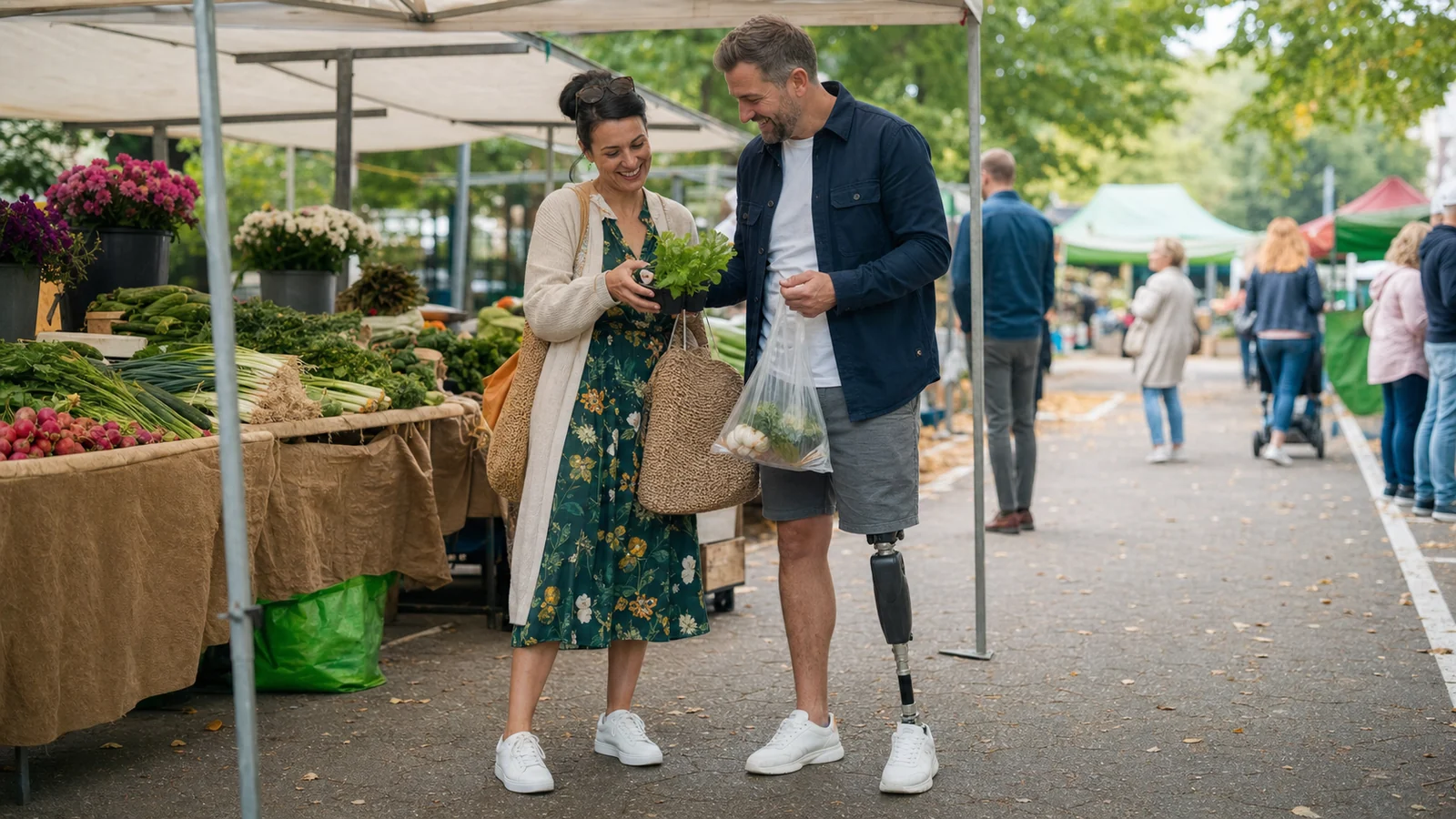
Amputee dating can bring ordinary excitement alongside a few decisions that non-amputees may never need to make: when to disclose a limb difference, whether to show a prosthesis in profile photos, how to plan around socket comfort, or how to respond to an intrusive question. There is no single correct script. The goal is not to make disability invisible; it is to keep personal choice, attraction and mutual respect in the foreground.
A useful starting point
You control when and how you share. A good date does not require you to educate someone about every part of limb loss. Give the information needed for comfort and consent, notice whether the other person listens without pity or fascination, and keep the plan flexible enough for your body on that day.
Choose a disclosure pace that protects your comfort
Some amputees put a prosthesis or limb difference clearly in profile photos because it filters out people who react poorly. Others lead with hobbies and personality, then mention amputation after a conversation develops. People who do not wear a prosthesis may have different visibility and access concerns. All are legitimate approaches.
A three-level disclosure ladder
Disclosure can happen in layers rather than one large explanation. The first layer is functional: “I’m a below-knee amputee, so a place with seating works best.” The second adds personal context if you want it: “Long walks can irritate my socket, but shorter routes are fine.” The third may include the cause of amputation, surgeries, pain or emotional history. No one is entitled to the third layer because they matched with you.
| Timing | Possible benefit | Possible concern | Helpful boundary |
|---|---|---|---|
| In the profile | Reduces surprise and can invite compatible people. | May attract intrusive attention. | “I mention it for context, not for a medical interview.” |
| During messaging | Allows some trust before sharing. | Can create worry about the reaction. | Share one practical fact, then return to the conversation. |
| Before meeting | Supports venue and activity planning. | May feel like a formal announcement. | Connect it to the plan: seating, distance or transport. |
| In person | Keeps early chat focused on personality. | Visible difference may surprise the other person. | Choose a public setting where you can leave independently. |
When a person responds with calm interest—neither avoidance nor interrogation—that is useful compatibility information. If they accuse you of hiding something, sexualise the limb difference immediately, or demand proof, you are allowed to end the exchange.
Build body confidence without demanding constant positivity
Confidence is not the absence of self-conscious days. Residual-limb changes, scarring, phantom sensations, weight shifts or a new prosthetic fit can affect how someone feels in their body. The Amputee Coalition’s below-knee guide notes that body-image concerns are common and adjustment is personal. Its amputation resource also points readers toward peer support, which can help normalise experiences.
For a profile, choose clothes and poses that feel like you rather than trying to prove fearlessness. One clear face photo, one full-length photo and images connected to real interests give a fuller picture. If you include a prosthesis, let it be part of the scene instead of the entire story unless advocacy or adaptive sport is central to your life.
Notice the difference between attraction and objectification
A partner can genuinely find scars, a residual limb or a prosthesis attractive. Objectification begins when curiosity replaces recognition of the whole person, when someone pushes for images, or when a fetish becomes more important than consent. You can ask directly: “Are you interested in me, or mainly in my amputation?” A respectful person will not punish the question.
Plan dates around energy, terrain and prosthetic comfort
Amputation affects people differently. A lower-limb amputee may manage stairs but need breaks; an upper-limb amputee may want a different table setup; a person using crutches may need firm ground and somewhere to store them safely. Heat, sweat, skin irritation, swelling, socket fit and phantom pain can change within a day. Ask what works now instead of relying on a general rule.
Match the activity to the day
- Low-demand: a café with supportive seating, pottery painting, a film, a bookshop or an online cooking session.
- Moderate: a compact gallery, a market with rest points, mini golf with step-free paths or a short waterfront route.
- Active: adapted cycling, swimming, climbing or a longer trail chosen by the amputee who knows their equipment and endurance.
Do not interpret a last-minute adjustment as disinterest. A socket problem can make standing painful even if yesterday went well. Offer a smaller plan: “Would sitting somewhere nearby work, or shall we choose another day?” The response respects both the connection and the body.
Pack the plan, not the pressure
Confirm distance, surfaces and seating. Keep the first meeting reasonably short, make transport independent, and identify a nearby alternative. The person with the limb difference should decide what equipment or supplies they need; a date does not need to create an emergency kit on their behalf.
Handle questions, awkward reactions and boundaries
Many non-amputees are unsure what language to use. Straightforward terms—amputee, prosthesis, residual limb—are usually better than dramatic euphemisms, but individual preference wins. If you use the wrong term, accept the correction and continue. A long apology makes the amputee manage your discomfort.
Questions that usually need more trust
The cause of amputation, surgical details, bathroom routines, benefit payments and sexual function are personal. A question may be appropriate later when both people are sharing vulnerable histories. On an early date, ask about the person’s experience only if they open the door.
- “I’m comfortable sharing the practical part, but I keep the medical history private until I know someone better.”
- “Please don’t ask for photos of my residual limb. That isn’t part of getting to know me.”
- “My prosthesis is equipment, so ask before touching it.”
- “I’d rather talk about what we both enjoy. What made you choose that travel photo?”
A thoughtful date may ask, “Is there anything useful for me to know about tonight’s plan?” That question focuses on support without assuming incapacity. It also leaves room for “No, I’ve got it.”
Talk about intimacy with clarity and warmth
Sex and affection after amputation vary as widely as they do for anyone else. Comfort may depend on whether a prosthesis stays on, how pressure falls on a residual limb, skin sensitivity, balance, fatigue or phantom pain. None of those details can be guessed from the level of amputation.
Before intimacy
Use open questions and make stopping ordinary: “Is there a position that feels better?” “Do you want the prosthesis on or off?” “Tell me if pressure there changes.” Attraction and practical communication can exist in the same moment. Avoid treating adaptations as a problem to solve; experimentation belongs to both partners.
When body-image worries appear
Reassurance works best when it is specific and believable. “I love how close we feel” or “You look beautiful in that shirt” may land better than insisting a visible difference does not exist. If your partner wants lights low, more clothing, or time before a scar is touched, respect the pace without withdrawing affection.
Create an equal partnership beyond the first dates
Long-term compatibility includes daily rhythms: prosthetic appointments, equipment costs, pain fluctuations, work and family. Discuss them as shared information, not evidence that one person is a burden. An amputee partner may sometimes need practical help and may provide support in many other forms. Equality is not identical output every day; it is mutual agency and care over time.
Keep separate interests and friendships. If one partner becomes the default organiser of all accessible plans, rebalance the labour. If the non-amputee partner begins speaking for the amputee in public, agree on a signal that returns the conversation. Small habits protect autonomy.
Online safety remains important. Do not share an address, financial details, prosthetic funding documents or explicit images under pressure. Meet publicly, tell someone the plan and keep your own route home. Read our dating privacy guide for a paced approach to personal information.
Good amputee dating is not defined by perfect confidence. It is built from a series of ordinary, respectful choices: share at your pace, ask before touching, plan for comfort, remain curious about the whole person and let attraction develop without turning difference into spectacle.
Amputee Dating FAQ
When should I disclose an amputation while dating?
There is no required moment. You may disclose in your profile, during messages, before meeting or in person. Share earlier when a practical detail affects the plan, but keep medical history private until you want to discuss it.
Is it okay to ask about a prosthesis?
Ask only when the answer is relevant or the person invites the topic. Do not touch a prosthesis or residual limb without clear permission.
What first dates work well for an amputee?
Choose an activity that matches the person's current energy, terrain preference and equipment. Reliable seating, a short route, an independent trip home and a backup option make many ordinary dates easier.
How should I respond if someone fetishises my amputation?
State the boundary once if you feel safe, save evidence, then block and report persistent sexual comments or image requests. You do not owe an explanation.
Can prosthetic comfort change during a date?
Yes. Heat, swelling, skin irritation, socket fit and pain can vary. A flexible date can move to a seated activity, end earlier or be rescheduled without treating the change as rejection.
This guide offers general dating and access-planning information, not medical or legal advice. Individual needs differ; ask the person and respect their answer.
Meet People Who Value the Whole You
Build a profile around your interests, values and relationship goals, with control over what personal information you share.
Create Your Free Profile